Another economy is possible
“The neoliberal economy is a cultural artefact.” Culture can remake the economy into the one we need.

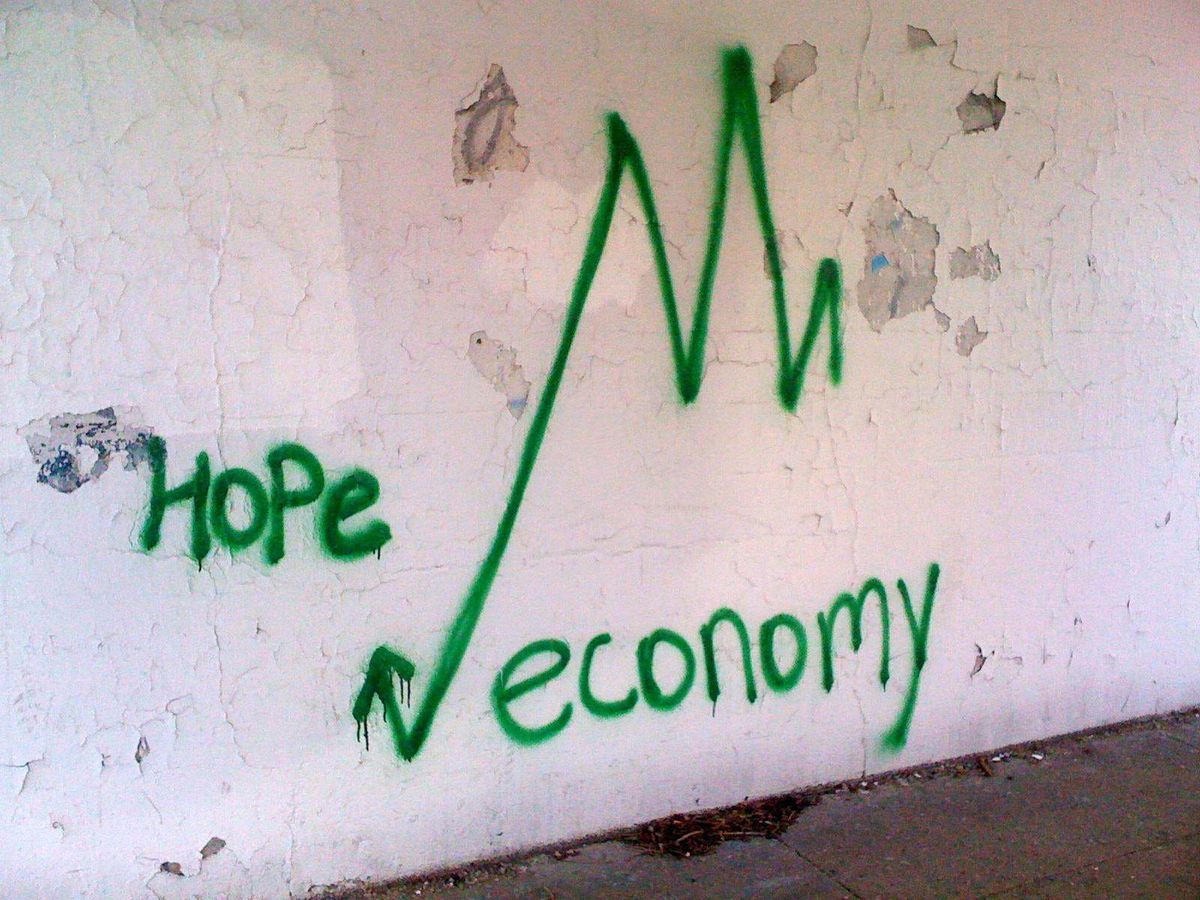
Two thinkers we’re inspired by at Absurd Intelligence are Ursula K Le Guin and David Graeber. Their work circles around each other like the ouroboros (the two headed snake of eternal cycles: destruction and rebirth, infinity, and unity).
One idea they both expressed is this (I’ll use Le Guin’s version, as I’ll be using other Graeber quotes later):
“The exercise of imagination is dangerous to those who profit from the way things are because it has the power to show that the way things are is not permanent, not universal, not necessary.” ‘A War Without End’, 2005.
Perceiving our Economy
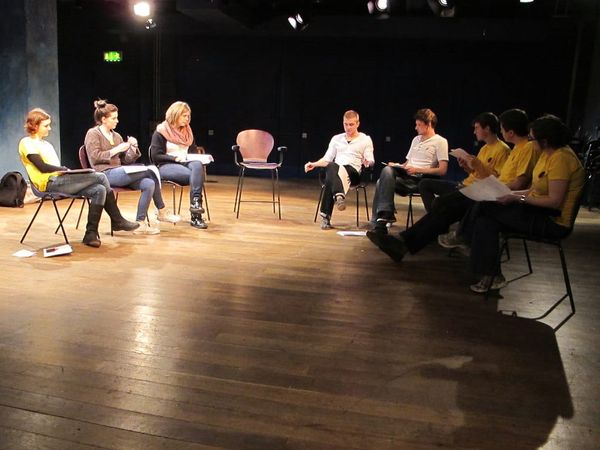
This thinking was channeled at the Friends Provident Foundation’s conference on ‘Shifting Cultural Perceptions of our Economy’ that took place Wednesday in York. The founding Director of Friends Provident Foundation, Danielle Walker Palmour, expressed it when bringing together the economy with culture, as the space in which perceptions of the economy are created and shifted or maintained.
“The neoliberal economy is a cultural artefact,” said Walker Palmour. "Neoliberalism was foremost and explicitly a cultural project – recognised as cultural.”
It was created to battle Communism, and get the state out of the economy. And from there, we’ve ended up with a global economic system that is a racket and a ratchet, concentrating ever more wealth into the hands of a billionaire elite – for example, in the UK, just 50 families hoard 50% of our entire country’s wealth.
Culture in the Dock
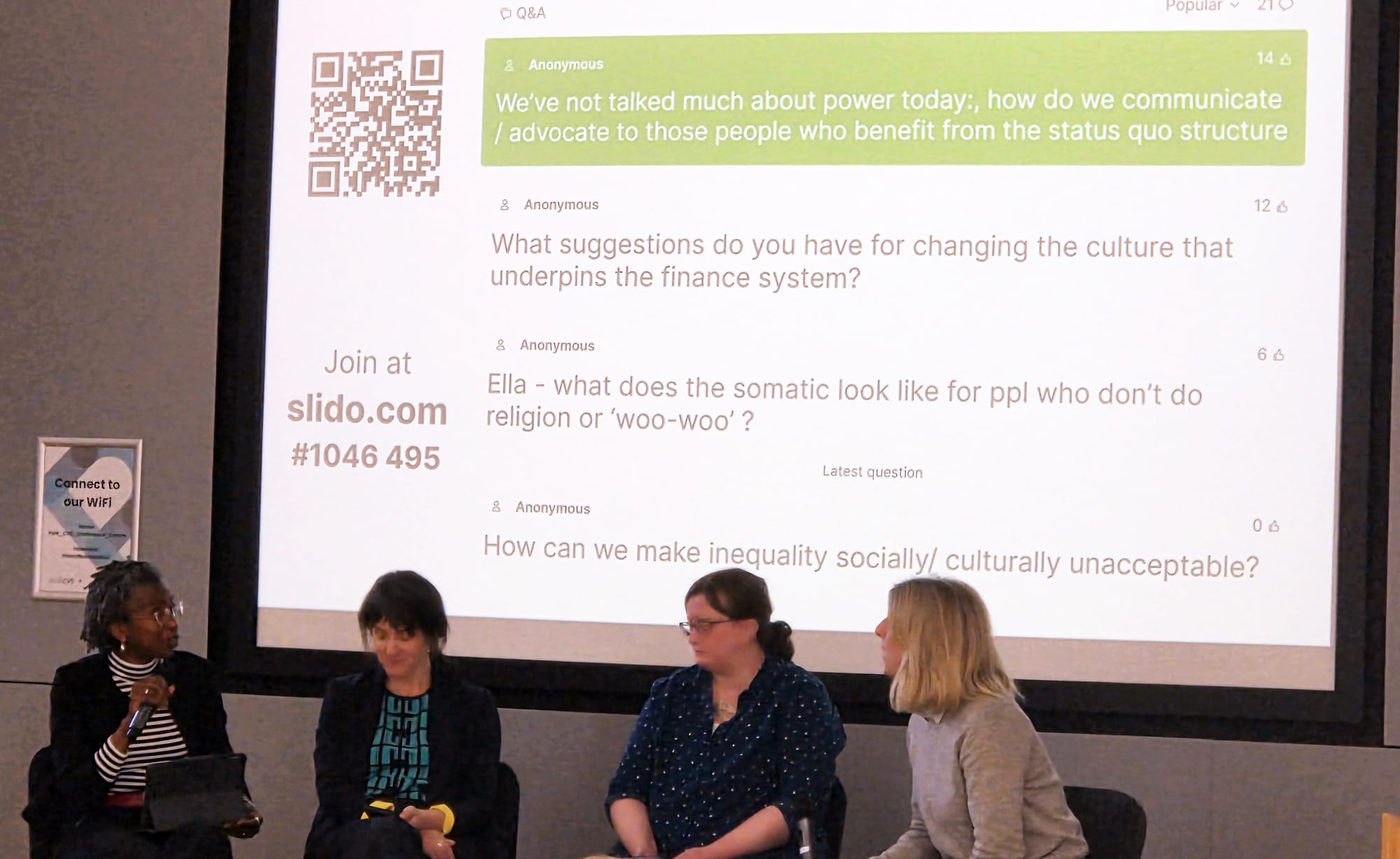
Which is why narrative strategist Ella Saltmarshe, in her keynote presentation to the conference, put culture “in the dock” with the economy: charged as responsible for the stories of the economy that dominate our lives and interactions. Culture is the soil out of which everything grows: but that includes neoliberalism and extractive economics. As with Le Guin, though, this is a reminder that what we plant in the soil changes the soil. We can grow a different economy.
(Interesting that during the ‘mud moment’ which Ella gave us all to explore the ideas she was presenting, that the person I spoke with, from the world of finance reform, had always placed the economy as foundational, with everything else, culture, politics, society, etc, flowing from the economic bedrock.)
The field of narrative change (in which we at The AI have pitched our tents in anticipation of the festival of dangerous imagination we’re all invited to) has over the last few years matured. We are storied beings who make meaning through story; as these stories accumulate around us, they ‘enculturate’ us – embedding us in what ‘makes sense’. The long-term trajectory of this is the creation of societies and cultures, habits, practices, institutions and structures that we take for granted as common sense. It’s just the way it is; the stories we go by.
A well-nurtured field
Ella Saltmarshe, through for example the Long Time Academy, and others have also pitched their tents in this field and have their wellies on (Paddy Loughman, Ruth Taylor, Dan Stanley and Future Narratives Lab, many more!). The open and inclusive approach they’ve taken to nurturing this field, their willingness to flex and respond to critique, has been central in this maturing. Shared to the attendees on Wednesday was research (funded by JRF) that has taken an open-field convening approach to what kinds of tools – learnings, guidance, thought-leadership – would be useful to campaigners, practitioners, reformers, radicals, all interested in the call – on Wednesday, that another economy is possible. How do we shift the perceptions from something inevitable, rigged, and ‘not for us’ to one that is in service to a flourishing sense of wellbeing?
The work Ella shared presented four ways in which we can work with culture to change perceptions (as Ella reiterated, there are undoubtedly more than four; also, these are my paraphrased descriptors):
- Excavate – to combat the naturalisation of ‘this is how it is + has always been’
- Signal – to show what is already happening, highlighting alternatives
- Tend – to cultivate the values and mindsets that bring about alternatives
- Imagine – to show the possible future worlds filled with these new systems
Mapped against the Berkana Two Loops Model, Ella talked through the ways in which these practices work at a system level – and in particular, to connect and cohere the isolated pioneers of the new, alternative systems.
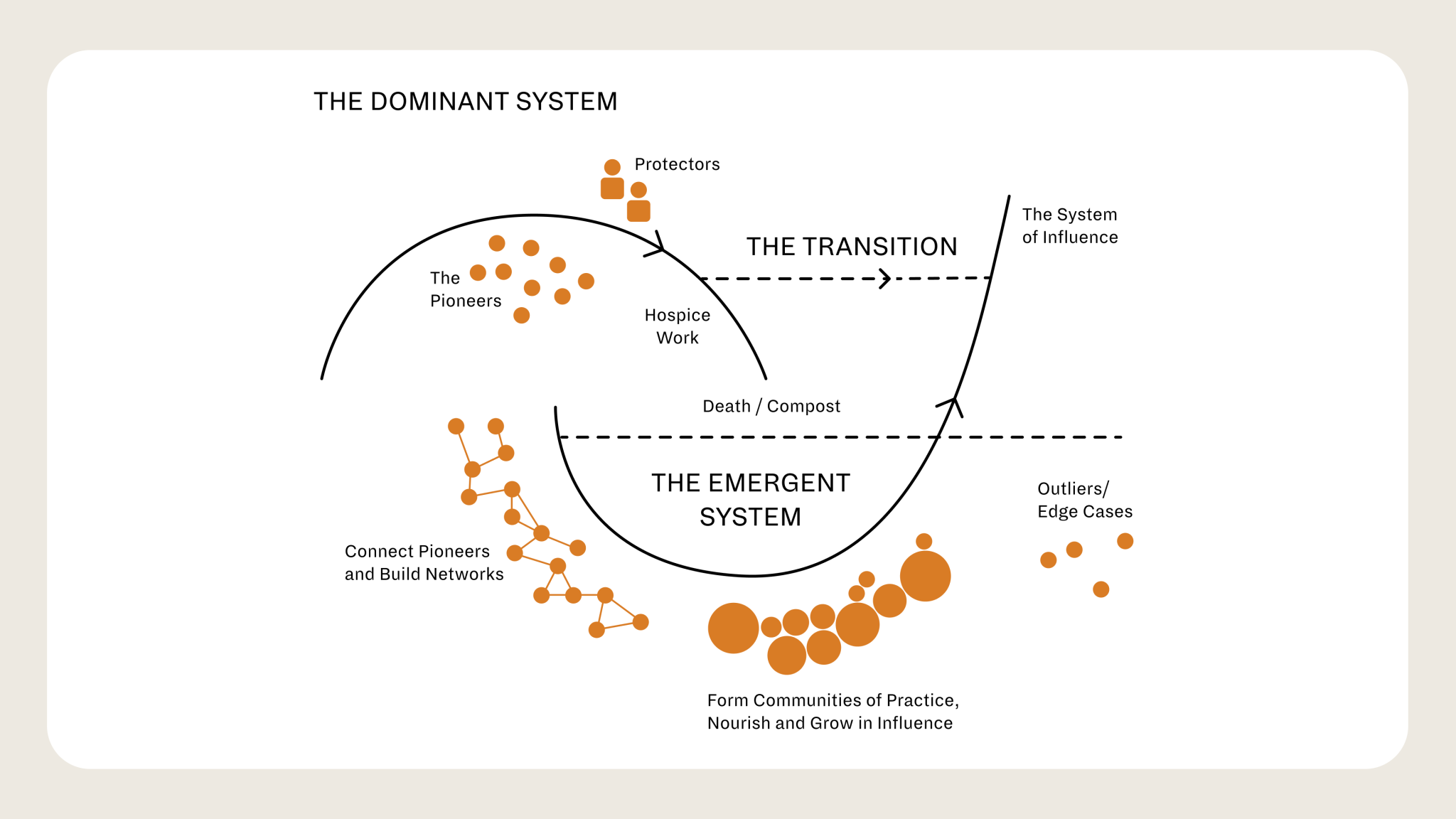
(Which is what I think we are doing with The Fête of Britain as signalling and imagining, and particularly perhaps tending, by convening the people building the new worlds.)
Frontierlands
And is what Frontierlands: Britain’s Survival in the Making, the new book from Hazel Sheffield, is all about – Hazel was the other keynote speaker. Her book was similarly generous, detailed and signalling-tending of the many projects already modelling new spaces and economies. These included:
- Onion Collective, and their art gallery in Watchet, Somerset
- Hastings Commons, and their regeneration of the Observer Print Building
- Civic Square in Birmingham, e.g. their neighbourhood trade school
It was reassuring that the examples were all people we have in some way already connected with. Reassuring, because as Damon Centola wrote about in his book Change, an ecosystem is built, and becomes resilient, not through ‘hero’ connectors with a thousand contacts (the hub and spoke model) but through lots of people being connected to lots of people in the same organisations and across the same space.
Which is an advert for Hazel’s book, and the work she put into making it, supported by grants from Friends Provident Foundation.
Values > Value > Values
One of the central questions of the conversation about the economy and perceptions, narrative and stories, is: who gets to define value?
I’m raising this question for two reasons. First: to prompt our Charlie into writing the newsletter piece he’s been threatening to do for a while, on how we can replace the concept of “value for money” with a better metric for the way we interact with one another: a “value for trust”. (Part of our “love is the work” series.) Come on Chazza!
Second: it was the question that Sarah Teacher from the Impact Investment Institute asked attendees at her conversation corner after lunch.
Who gets to define value?
Sarah told the story of her organisation’s campaign: The Resilience Conversation. It came about after research to understand what investors cared about: and it wasn’t moral concern for sustainability or environment.
To reach their audience, the Impact Investment Institute changed tack. From Values to Value, as Sarah put it: to connect with their identity as an investor. And mostly, monetary value. Hence the Resilience Conversation for long-term change. (Sarah was also very honest and wanted to engage with the room on whether this was a win, or a compromise. My thought: can’t it be both?)
Anyway, which is not a surprise. But, what is value, and how is it defined?
When you search the dictionaries, Chambers, Cambridge and most others (the OED is behind a paywall) the first and therefore most commonly used meaning of value, is a version of “worth in monetary terms”.
This wasn’t always the case. Value stems from the Latin valere (“to be strong, be well, be worth”), tracing back to the Proto-Indo-European root *wal- (“to be strong”). Its connection to monetary value only came into dominance around the 14th century.
A large part of that is to do with the growing dominance of capital, trade, and liberalism as the dominant values of value.
A unit of trust
Which is where David Graeber comes in.
In Debt: The First 5,000 Years, he wrote of this original meaning of value:
“The value of a unit of currency is not the measure of the value of an object, but the measure of one’s trust in other human beings.”
Value as a measure was later captured by capital. Which is a shame really (understatement of the millennium) that trust in other humans has been pushed to the margins of how we measure worth.
One reason why this can happen is because value, as a word, is a metaphor, and metaphors are malleable. A metaphor is of course a figure of speech that directly compares two unrelated things by stating one thing is the other.
Value is itself a figure of speech – it is a concept we use to help us measure, contrast, evaluate, and select. It is often qualified, e.g. value for money.
Metaphors we live by
Back in 1980, George Lakoff and Mark Johnson wrote Metaphors We Live By, which explored how metaphor is a tool that helps us use what we know about our direct physical and social experiences to understand more abstract things like work, time, money, even (and perhaps especially) our emotions (when your temper boils over, etc).
This is important, as much modern political campaigning messaging and framing leads back to the work of Lakoff (Don’t Think of an Elephant), and his influence on people such as Anat Shenker-Osorio and Ian Haney Lopez, and the work of places such as PIRC, Neon, Frameworks Institute, and others.
So much of our understanding in this field is built upon linguistic analysis of the way in which metaphor works. As Jonathan Rowson at Perspectiva said once, the work we need to do to deal with the current shitshow (what he called ‘the pickle we’re in’) is “metaphor design”.
The way most people understand the economy is through metaphors. PIRC did the baseline work on this a decade or so ago, in their report Framing the Economy. Their research showed that people think of the economy:
- As a container
- As money
- As on the edge of disaster
- As rigged
- As driven by mysterious forces
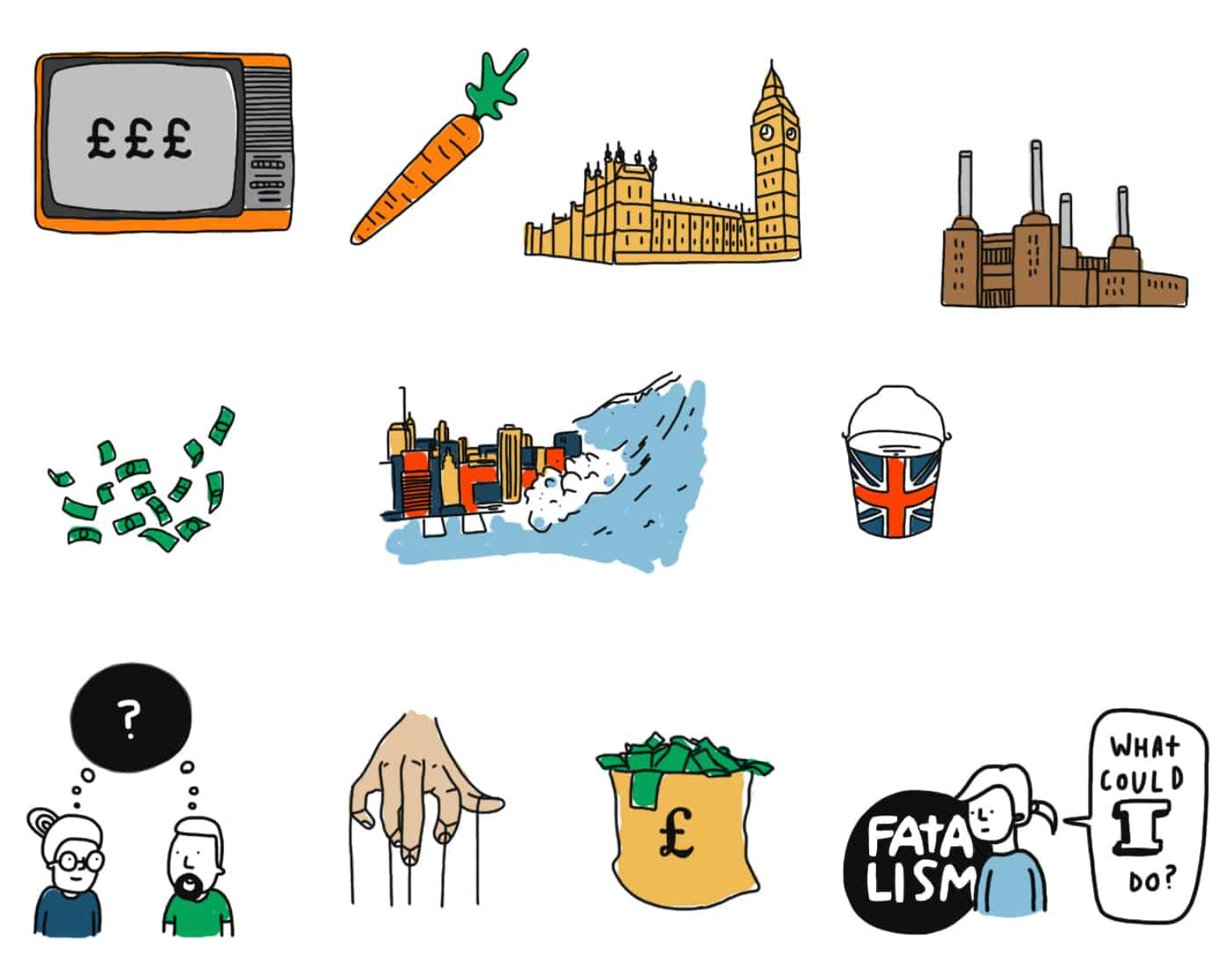
All of these metaphors, it can be argued, are products of and reinforce neoliberalism. E.g. Adam Smith’s invisible hand, which only elites and financiers understand. As Claire from the awe-inspiring Poverty Truth Network admitted, she used to think of the economy in terms of maths, and things she didn’t understand, so it wasn’t for her.
That is: the cultural project of neoliberalism relies massively on the metaphors of how the economy is understood to work.
Replace production and consumption with..
Which brings us back to where Danielle Walker Palmour began, talking about neoliberalism as a cultural artefact.
We’ve spoken for a while now, inspired by Graeber, about replacing production and consumption with the values of care and freedom, as a better way to organise ourselves, and one that will avoid the worst of the catastrophes that, no matter what we do, are coming our way.
This also resonated with words from Hannah Paylor from Carnegie UK. The resonance here was on relationships, and reorienting our measures of value towards a relationship-first society, politics and economy. The way Graeber puts it is this:
“[w]e need to move away from a paradigm of production and consumption as being what an economy is about, because if we’re going to save the planet, we really need to move away from productivism. I would propose that we just rip up the discipline of economics as it exists and start over. This is my proposal in this regard: I think that we should take the ideas of production and consumption, throw them away, and substitute for them the idea of care and freedom. ‘From Managerial Feudalism to the Revolt of the Caring Classes’, 2019.
Succinctly, but no less powerfully, Hannah put it like this: “We need to replace production and consumption with relationships” as the measure of our economy.
We’re calling it The Care and Freedom Economy. And we’re in the business of a cultural invite to how we imagine this new economy as a way to share our resources while tending to this each other and this planet, our home.
So, some questions to end:
- What role are you playing in shifting the perceptions of our current world: excavator, signaller, tenderer, imaginer?
- What definitions of value do you go by?
- And will Charlie write his piece on the value of trust by next week?!
Elsewhere in Absurdity…
Clare and Charlie went to see Es Devlin’s new participatory artwork A National Portrait for the National Portrait Gallery, even though Charlie should’ve been writing next week’s newsletter.
Stella and Charlie (again 🙄) saw our ace mate Jenn Reid sing Songs For The Workers with Billy Bragg at Cecil Sharp House.
Alanna and Clare went to hear the brilliant Natasha Walter at Conway Hall, sharing from her new book Feminism for a World On Fire.
Stella, Alex, Clive and Charlie were all at Hard Art to hear the (also brilliant) architect Michael Pawlyn open up the session on theories of change with a whistle stop tour through systems thinking.
While Tracey was on another recce to build relationship in Wigan, ahead of our planned Fête of Wigan taking place there this summer.
And finally Clive is being an intentional anarcho-punk at the Right to Protest exhibition at Rockaway Park.