This is What Multicultural Democracy Looks Like
A guest post on the lessons from Gorton and Denton for multicultural democracy, from Lee Jasper, co-founder of Operation Black Vote and co-convenor of the Humanity Project.
(This post was originally published at https://leejaspersnr.substack.com/.)
Over the last few weeks I have been listening carefully to the voices coming out of Gorton and Denton. I confess that hearing those unmistakable Mancunian accents dominate the national news agenda has been quietly refreshing. That dry timbre that wastes no words and tolerates no nonsense. It is the same grain I grew up with on the other side of the city.
I was born in Lower Broughton, Salford, north west of Manchester city centre. Gorton and Denton sit to the south east. Different streets. Different bus routes. The same civic bloodstream.
In the nineteen sixties Lower Broughton and neighbouring Cheetham Hill were working class and industrial, wrapped around the warehouses and arteries of the Manchester Ship Canal. It was not fashionable. It was not curated. It was simply lived. Jewish families, African families and Caribbean families lived cheek by jowl. My uncles picked up enough Yiddish to get by because proximity makes language practical. A Jewish factory owner would invite neighbourhood children into his cushion workshop in the summer to dive into mountains of multicoloured foam offcuts. I remember walking into Jewish grocers with my Sierra Leonean grandfather and my British grandmother and leaving with an extra sweet pressed quietly into my hand.
It was ordinary solidarity. No policy paper required.
And when racist violence and intimidation surfaced, as it did in that era, communities did not retreat behind suspicion. They understood something instinctively. If one group’s legitimacy was questioned, everyone’s security weakened.
That memory matters now.
We have already seen how quickly community-targeted messaging becomes the story, the scandal and the distraction in Gorton and Denton, and before that in Rochdale where candidate conduct and community framing eclipsed the wider political argument. Outreach is legitimate. But in today’s climate narrative control is merciless. Mistakes or even ambiguities travel faster than fact.
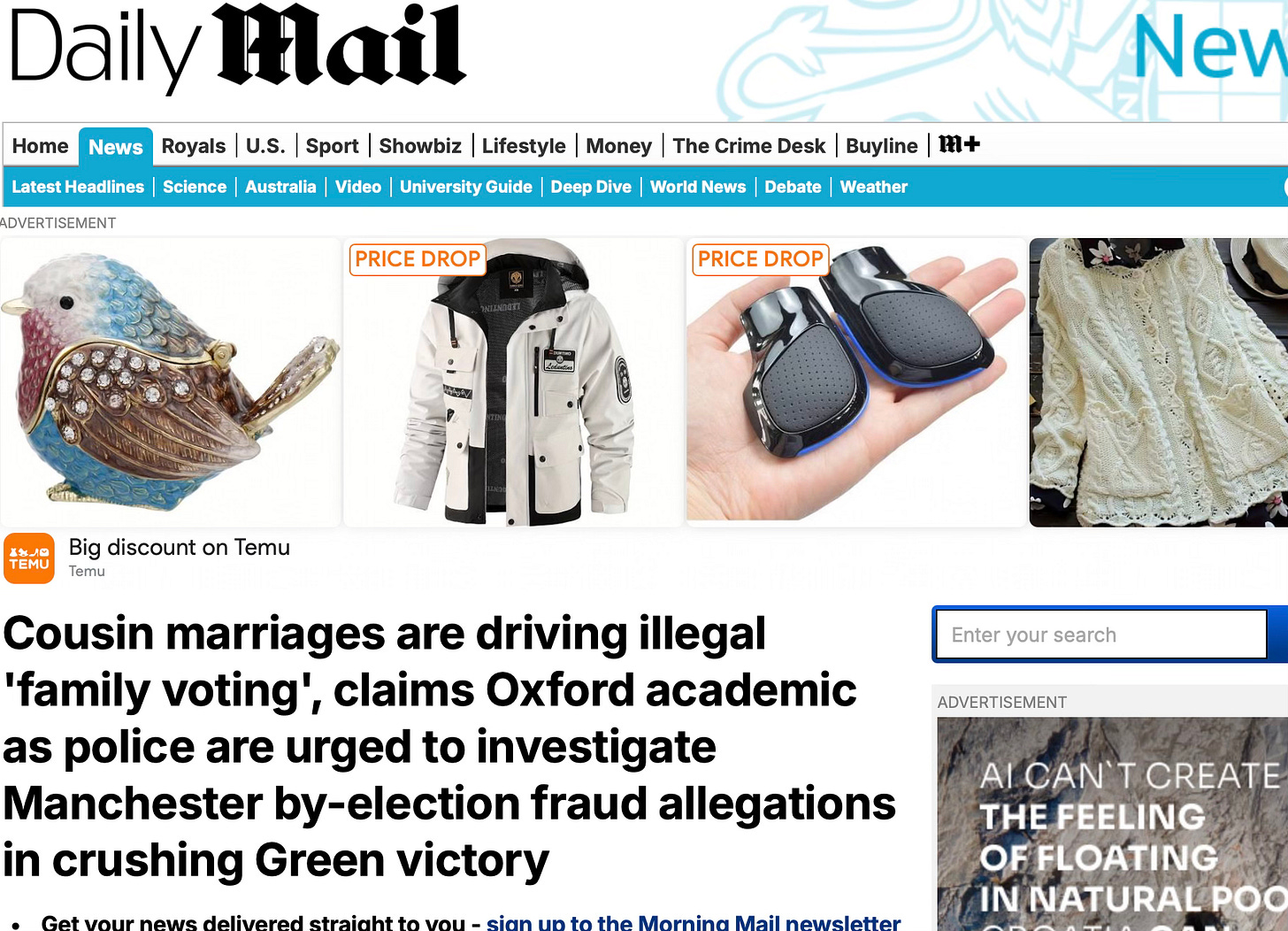
Because in the aftermath of Gorton and Denton we heard a familiar insinuation.
The moment Muslim communities participated decisively, something must be wrong.
When Participation Is Reframed As Suspicion
After defeat, Reform reached for the language of Muslim sectarianism. Allegations of “family voting” circulated before any substantiated evidence was tested.
Let us look at that calmly.
When pensioners vote in their interests, no one questions their legitimacy. When rural communities align around agriculture, their cohesion is not pathologised. When homeowners consolidate around property values, it is simply politics.
But when Muslim voters help decide a marginal seat, suspicion attaches.
Coercion inside a polling booth is illegal. If credible evidence exists, it should be investigated through due process. But insinuation deployed immediately after defeat does not defend democracy. It casts doubt on the citizenship of entire communities.
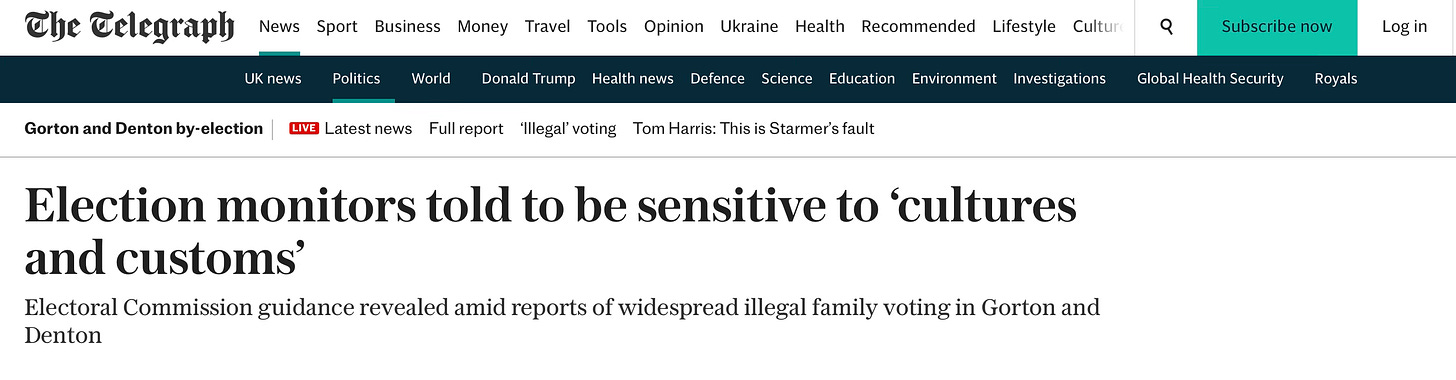
Even more troubling was the speed with which parts of the media amplified the framing. Controversy travelled faster than verification. Suspicion became headline before it became fact.
Democracy depends on losers conceding without stigmatising voters. It depends on journalists interrogating claims before magnifying them.
When that discipline weakens, trust erodes.
And we’ve heard this story before.
When Lutfur Rahman was removed by an Election Court in Tower Hamlets in 2015, the ruling was specific and legal. Election courts have existed for more than a century and have unseated candidates before. What made Tower Hamlets politically explosive was not the existence of due process but the way legal findings merged, in parts of the commentary, with broader suspicion about Muslim political organisation.
The lesson is simple. The law must apply equally. Scrutiny must be evidence based. It must not drift into cultural presumption and crass stereotype..
In Gorton and Denton there has been no legal threshold crossed. Only suggestion. That distinction matters.
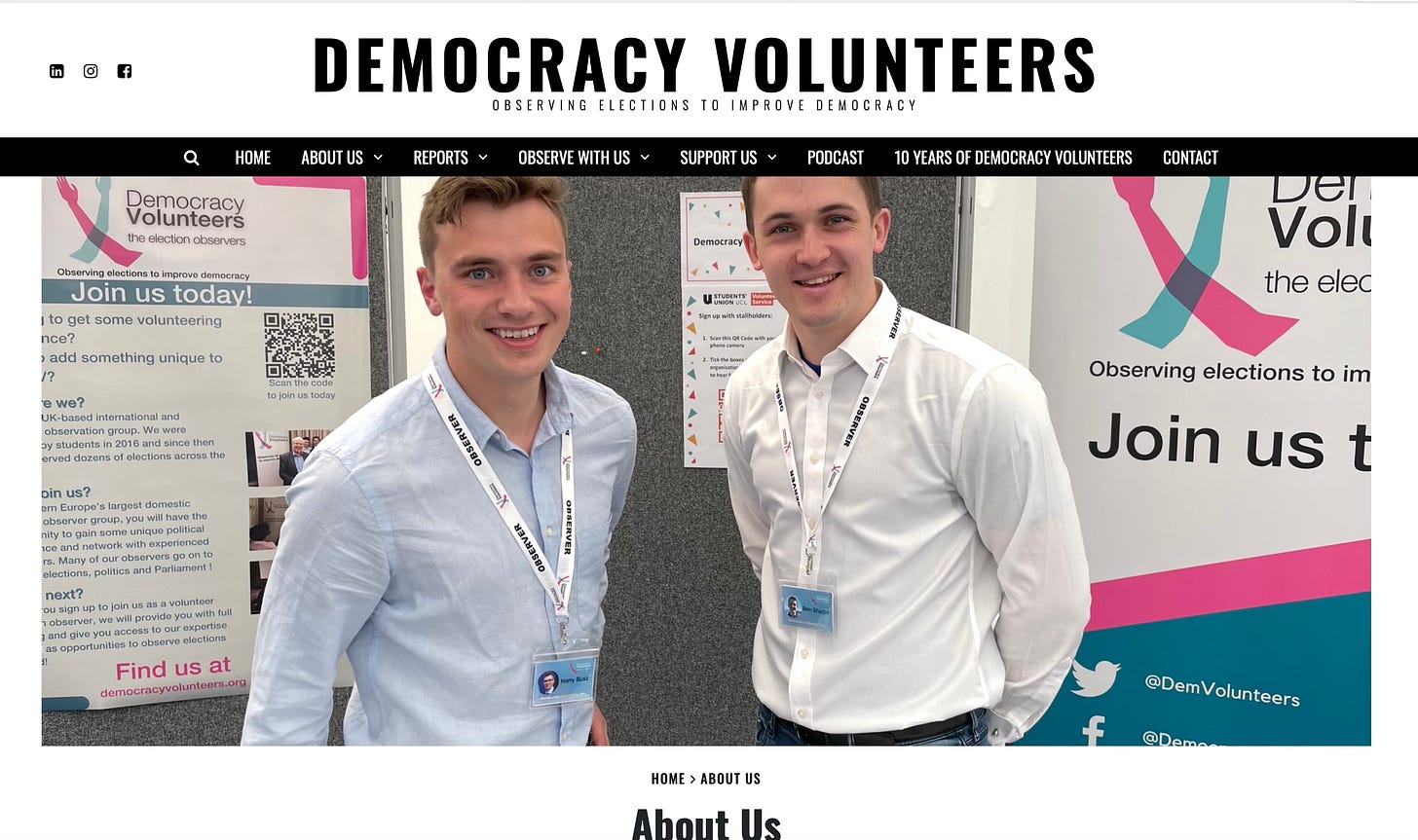
The claims that gathered pace after polling day did not emerge from a police statement or a formal legal petition. They originated in a post-election briefing issued by an independent election observation group, Democracy Volunteers whose intervention rapidly became the go to reference point for media coverage and political commentary.
Democracy Volunteers is not a phantom organisation conjured for one news cycle. It is a registered election observation group founded in 2016, accredited to observe UK polls, and it has published reports on previous elections. Its work has been cited in parliamentary debates and informed legislation relating to ballot secrecy.
But legitimacy of existence does not mean immunity from scrutiny.
In diverse urban constituencies, public-facing bodies that intervene in sensitive electoral matters should demonstrate not only independence, but cultural literacy. Where leadership and advisory structures appear demographically narrow, transparency about training, methodology and community engagement becomes even more important. In plural democracies, legitimacy is strengthened by representation or by clearly showing how representation gaps are addressed.
In Gorton and Denton the organisation deployed four volunteer observers who visited 22 of 45 polling stations for limited periods and then issued a statement after polls closed alleging multiple instances of what it described as “family voting”. Manchester City Council has said that no such concerns were raised with presiding officers during polling hours when any alleged breach could have been addressed.
There is no publicly available detail on the ethnic or cultural composition of the organisation’s leadership or volunteer observers which given their funding by the Jospeh Rowntree Reform Trust is interesting. . I can find no clearly published methodological framework explaining how observers distinguish unlawful coercion from lawful assistance, language support, disability related help, cultural habit, or simple ignorance of electoral rules. In a diverse urban constituency those distinctions are not trivial.
In a multicultural democracy, scrutiny must be culturally literate. Election observers operating in diverse urban constituencies should reflect or at least rigorously account for the pluralism of the communities they assess. Where leadership and observer teams appear demographically narrow, the burden shifts to methodology, training and transparency. Cultural competence cannot be assumed; it must be demonstrated.
If you are going to publish claims that will inevitably be read through the prism of Islamophobia in the current climate, methodological clarity must be rigorous. Without it, what is presented as electoral integrity can become a conduit for cultural suspicion.
There is no evidence that the alleged conduct altered the result or benefited any specific party. What we have instead is a limited observational claim amplified at speed into a broader insinuation.
Scrutiny strengthens democracy. Atmospherics do not.
Now step back from the noise.
The Arithmetic Reform Cannot Escape
At the last General Election more than one hundred constituencies were decided by less than five per cent of the vote. Many by only a few thousand votes. Power in modern Britain rests on margins.
Across London, Greater Manchester, the West Midlands, West Yorkshire, Leicester, Luton, Bristol and beyond there are dozens of constituencies where Black, Asian and minority ethnic communities form between a fifth and half of the electorate. In many of those marginal seats the minority electorate alone exceeds the previous winning majority.
Add progressive white voters who reject ethnonationalist politics and you have a metropolitan coalition that is not symbolic but decisive.
This is not bloc voting. It is arithmetic. I invite the Daily Mail and GB News to do the maths.
In a tight national contest metropolitan multicultural Britain determines power. The fact is Metropolitan Britain is irreversibly and increasingly diverse.
Every time Reform questions the legitimacy of Muslim participation it may generate applause in culturally anxious corners. But it simultaneously consolidates resistance in the very constituencies required to form a government.
You cannot build a governing majority in modern Britain while narrowing who counts as British.
The numbers do not permit it. Unless you are prepared to strip citizens of their right to vote, a proposition that should be unthinkable in any functioning democracy, the electoral arithmetic is fixed.
Yet in the current hysterical climate generated by the hard R right, ideas that once lived on the political fringe are edging disturbingly towards respectability. Talk of “re-immigration”, of narrowing belonging, of redefining who truly counts as British, and even of forced mass deportations, are no longer confined to late-night shock jock radio shows and fringe online comment threads. Today, alas, it is aired in studios and printed in technicolor headlines.
That is the danger.
When movements cannot win the numbers, the temptation is not to broaden appeal but to redraw the electorate. Democracies rarely collapse in a single dramatic act. They erode when exclusion begins to masquerade as restoration, and when the removal of rights is reframed as common sense.
Restore’s entry onto the stage, driven by personal rivalry, weakens the hard R right further. Even unity would not resolve the structural problem. Cities decide. Cities are diverse. Cities vote.
The nationalist wave may roar loudly. It must still pass through electoral mathematics. Mathematics does not bend to grievance.
A Necessary Word To The Wise
Breakthrough is the most dangerous moment for any insurgent political movement including the Greens .
Gorton and Denton was shaped by specific demographics and tactical alignment. It is not, in isolation, proof of inevitable national realignment.
Progressive parties are not immune from error. I have seen insurgent movements campaign one way in diverse urban constituencies and quite another in predominantly white areas where the Labour candidate happens to be Black, Asian or Muslim. Under pressure, shortcuts are taken. Imagery drifts. Cultural tropes slip in.
If the Greens wish to scale nationally they must embed serious anti-racist analysis across every candidate and every constituency. Race, class and environmental justice must be understood together. Anti racist leadership training and resilience must be delivered to their candidates and senior leadership. These are shark filled waters and the preset media traps must be anticipated before they are sprung.
The British press has a habit of building insurgents up and then subjecting them to relentless scrutiny. Drugs policy, immigration, protest, policing each will be reframed through hostile lenses.
Excitement fades. Discipline sustains.
The Democratic Deficit Beneath It All
Yet this debate cannot stop at arithmetic.
Britain still operates largely on a democratic model forged centuries ago. We enter a booth, mark a cross and withdraw. That ritual served the country in another age. It strains under the weight of a complex and diverse society.
First past the post distorts representation. Many voters feel unheard between elections. Decisions appear distant. Power feels remote.
Nothing corrodes working-class communities faster than powerlessness. In the deindustrialised towns and cities of the North and Midlands, alienation has accumulated for decades. Alienation feeds grievance politics.
The answer is not simply defeating one party at the ballot box. It is deepening democracy itself.

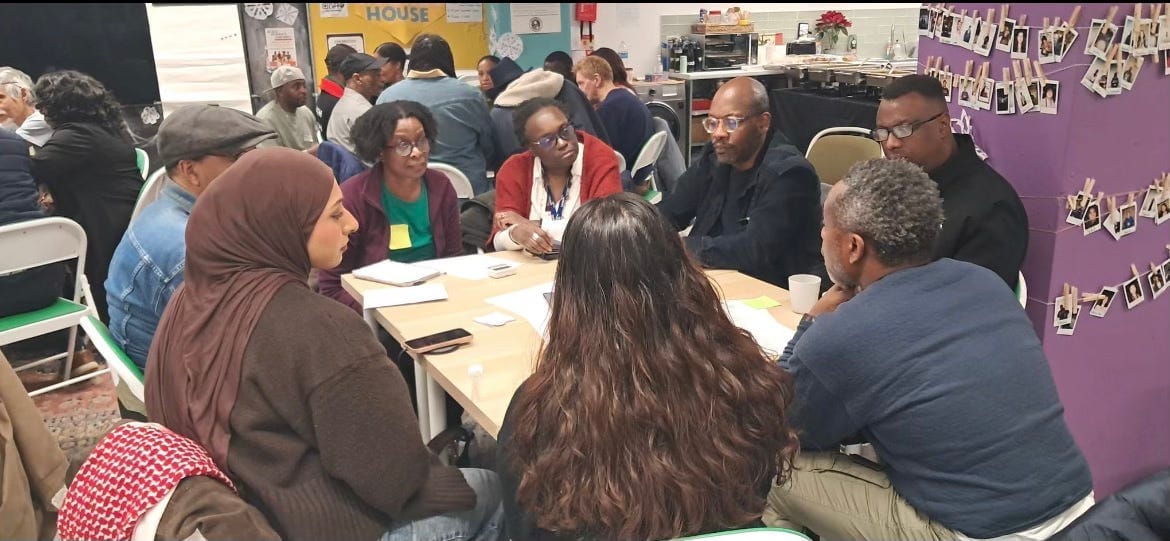
Through Operation Black Vote and the Humanity Project we are building structured spaces for popular and citizens’ assemblies across the country. Carefully facilitated interventions. Difficult conversations conducted with seriousness rather than slogans. When people deliberate together alienation weakens. When communities shape local decisions agency grows. When democracy extends beyond Westminster ritual, extremism loses oxygen.
This is not party politics, it’s democratic renewal.
If our political conventions cannot adapt to a diverse and economically transformed Britain, they will continue to fracture under strain.
The Warning Shot
At least form my persecutive though welcome Gorton and Denton was not a revolution.
It was a reminder.
Reform and Restore are not confused about what they are doing. Casting suspicion on Muslim participation and attacking equality law is not a misstep. It is an ideological position. It deserves political defeat, not polite correction.
The warning is for those who believe they are building something better.
The Greens have taken serious steps in developing an anti-racist framework led by Greens of colour. That matters. It is more than most parties have attempted.
But policy is the easy part.
Implementation is the test.
If you scale nationally, you will face sustained scrutiny on immigration, citizenship, protest, policing and race. Less diverse constituencies will generate pressures very different from metropolitan strongholds. The temptation will arise quietly, locally —to soften language here, to sharpen a cultural contrast there, to allow “community concern” to blur into something uglier.
That is how principle erodes. Not in conference halls. On doorsteps.
If anti-racism is foundational rather than decorative, then candidates must be equipped accordingly. Serious training. Clear red lines. An understanding of how race, class and environmental justice interlock in the British context. A refusal to mirror the cultural shortcuts of those you oppose, even when polling suggests it might land.
Breakthrough is exhilarating. It is also dangerous.
The margins are narrow. The electorate is changing. Metropolitan coalitions are decisive.
The nationalist wave will test itself against the lived reality of diverse Britain.
This time that reality is organised.
This is what democracy looks like.
Follow Lee here:
 Mr Lee Jasper Snr
Good Neighbours Episode 4: London Special
We’d love to invite you to the next episode! Our London special.

📆 Thursday 26th March
⏰ 6pm-8pm (show begins at 630pm)
📍 The Glassworks, 1c Montford Place, SE11 5DE
🎟️ Tickets are free but space is limited! Let us know you’re coming here.
🍻🥔 Refreshments will be served!
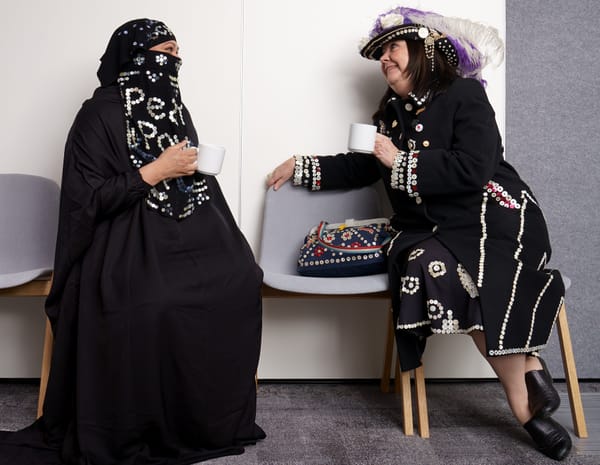
On this episode: Love Ssega will give us an update on his campaign to democratise the BBC. Saif Osmani and Andy Green on East End Bengali and the modern cockney. Gemma Blackie, the Pearly Queen of Fulham, will share stories from her life. We’ll hear from the Dilara, the first Turkish Muslim mum to run a pub in Barking. Marcus Lyon on The Glassworks and cycling across the U.S.A. Britain’s Got Tarot with Gandalfo, and more...
Elsewhere in Absurdity...
Well, this has been the time of cosmic battles for sure. As we approach the spring equinox and the planets line up to help us put our baggage behind us, we’re cleansing our portals for the pure energy of momentum coming through. Some (such as our dear friend Lee Jasper, above) have been deeply embedded in the battle against racism and fighting to imagine the future of multicultural Britain; while others in our crew have been faced with the more absurd, battling away in Agartha. Whichever battles you’ve been fighting, we hope you’ve won yours.
Meanwhile this week:
Charlie, Alanna, Clare, David, Maddy and Diya were in attendance at Hard Art, and we must give a big up to GNDR’s My Election Map.
Tonight, Clare is speaking as part of Dash Arts’ series of talks, We Are Free to Change the World, and both Maddy and Stella are working on the zine table there, definitely get down and imagine what kind of world you want to create.
Clare attended the South London Botanical Institute talk with Tracey Bush. Check out how beautiful her work is.
Diya was experiencing some Irish culture on St Patrick’s Day at the Shacklewell Arms. Lots of singing about ending capitalism and fascism!
...and finally. On Monday we told friends we would stop starting new things. By Thursday.... [WATCH THIS SPACE 👀].