What could be more British...?
Loud voices are calling for 'cultural coherence' and yet they seem to have short memories...


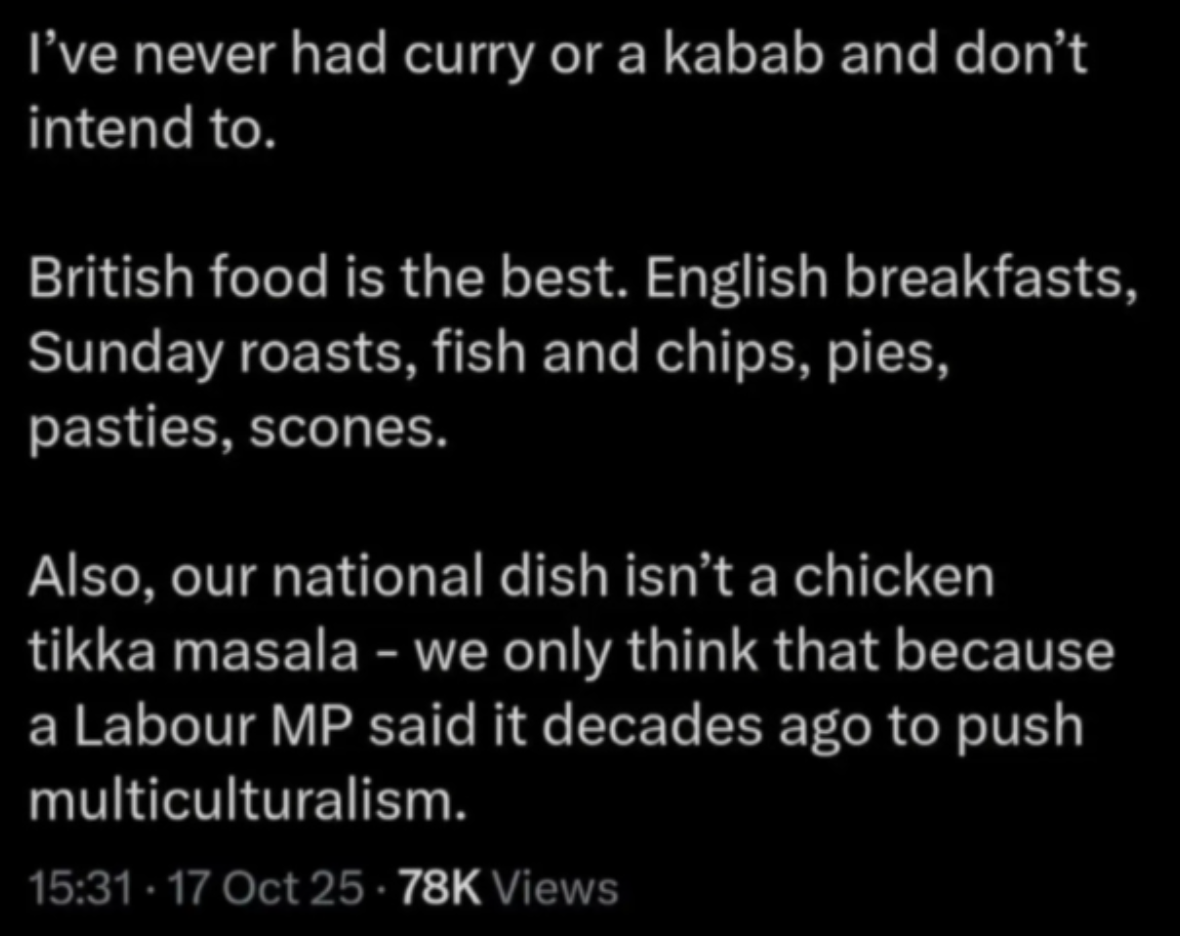
A few weeks ago now I saw this tweet, reposted on BlueSky:
Appropriately enough, I was in my local chip shop. I’d just order large cod and chips, and was told “10 minutes, mate”. I thought to myself, what could be more British than this chippy?
Waiting in the archetypal chippy
What makes a chippy? This one has the counter, with the fryer hidden behind, and already-cooked food behind glass. Mostly it is battered and deep fried. A saveloy. A veggie burger.
By the till there are two extra-large value-sized jars. One has a single remaining boiled egg, the other the last gherkin, preserved in some kind of liquid. They’ve both been the last of their kind for a few weeks now.
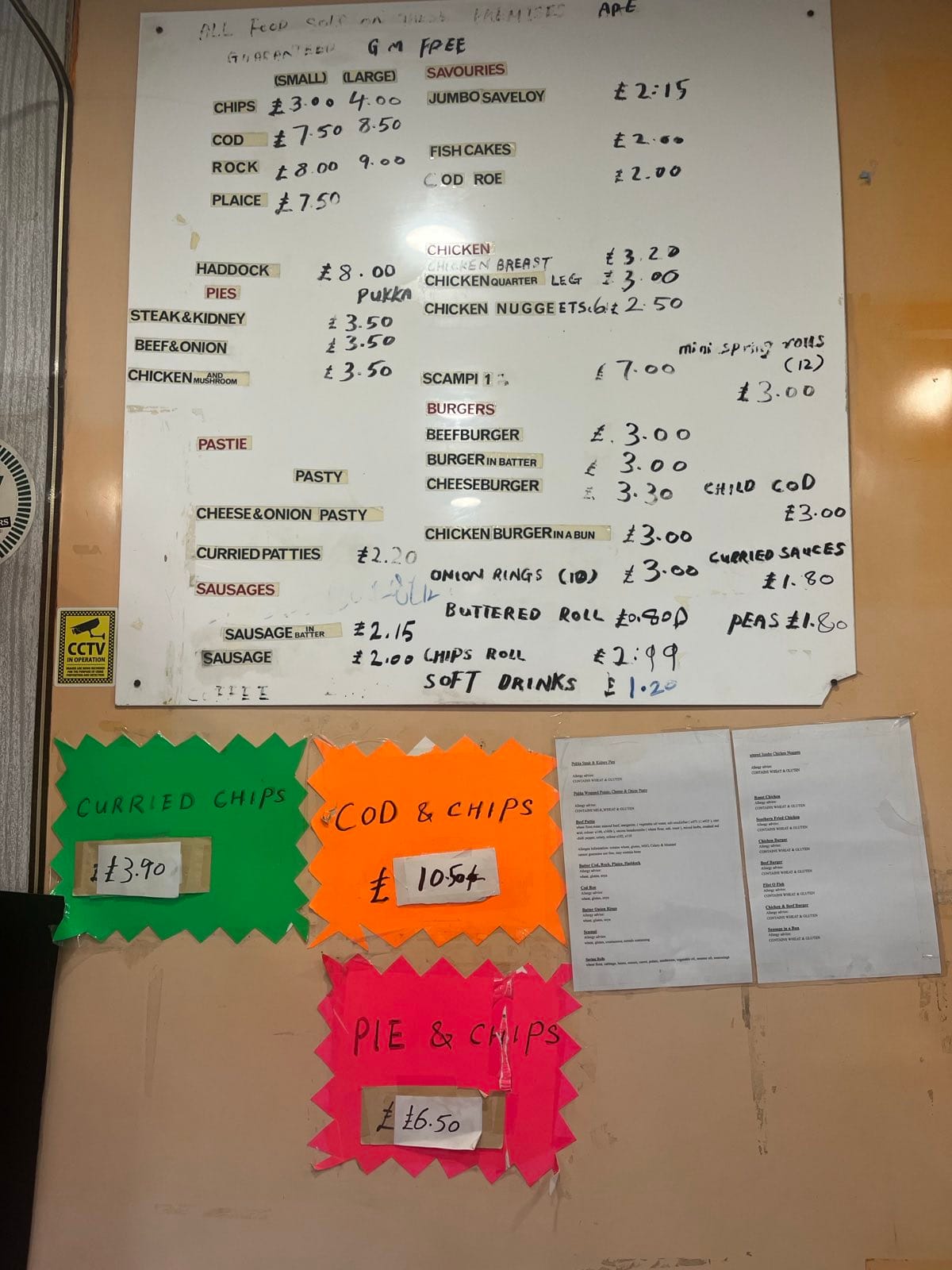
The prices are written out on a whiteboard, which is damaged on one side. You can see that the prices have all been updated at different times, by the fading and ink colour. Whoever wrote it all out was in a bit of a hurry, or didn’t care for straight lines.
On the opposite wall is a series of posters for a brand of pie. Each one is deliberately silly, and all are faded. They must have been up for over a decade.

Next to them is a small sticker from the local council. You have to lean in quite close to see it reads “should you be at school?”.

The lights are florescent, the decor cheap and cheerful. There’s a tall fridge of soft drinks with major and minor brands. There are, for some reason, two clocks, both wrong. It smells of hot fat, batter and vinegar, with a hint of cleaning fluid.
The fish and chips themselves are swiftly gobbled down by my teens. Standard local chippy fish and chips.
Anyone in Britain would recognise this as a chippy like their local, and the one from their childhood. What could be more British?
As British as…
It also sells pizza. Pizza is another popular Friday night takeaway, gobbled down by teenagers across the country. Definitively not a traditional British dish (although did the Romans eat pizza? No! Because tomatoes are from South America).
There is a certificate that says the shop belongs to the Chinese Restaurant Association. A bit confusing, as they don’t sell any. Presumably, an entrepreneurial experiment gone wrong. (A clue to why they failed: there is a Chinese restaurant next door.)
What would be more British, dismissed by Napoleon as a nation of shopkeepers, than trying out different offerings, to see what works in the local market?
“You’ll never get food poisoning from a chip shop. What could live in those temperatures?” — John Cooper Clarke
Then there is the constant flow of delivery drivers coming in and out. (Who walks to the chippy anymore? Me, I walk to my chippy.) We are in south east London; these are Brits whose families are from around the world.
The people who run the takeaway have an Afghan heritage. There’s a discrete flag in one corner. The person who served me is in the traditional apron and hairnet, and also looks a lot like Mo Salah, the hugely popular Liverpool footballer from Egypt.
I look back at the original tweet. It is actually part of a BlueSky post by writer Jonn Elledge:
“fish and chips, the native British dish invented by [S]ephardic Jewish migrants in the 18th century using a vegetable no one on this island had encountered before the 16th”
What could be more British than fish and chips — the dish of immigrants, made from ingredients which are not indigenous to our land, cooked and delivered by people who are even more recent additions to our great nation?
Fish and chips (and my local chippy) is as British as the contents of the British Museum — and all the better for it.
Monoculture is bad for you
All of this about my local chippy is of course a way of illustrating that anything called “British” including “British food” has a much more complex, mixed story than some would have you believe. But if you’re only looking for simple answers, you’ll probably only find them.
That’s bad for us all, though, culturally. In the year 2000, almost no one was talking about the need to get out of your bubble. But, with the rise of social media, most of us now know that we have a ‘bubble’ — the sources, like media organisations and friends, of your perspectives on the world.
In an argument someone might say “you’ve got to get out of your bubble”, meaning you are just getting a narrow range of perspectives that are self-reinforcing. Other views are available, and would deepen your understanding of the situation.
The field of cybernetics (aka systems thinking) has the Law of Requisite Variety, which says: if a system is going to adapt, then the internal complexity of a system must match the external complexity it is facing.
Put another way, monoculture – anything of a single source, seed, or idea – is bad for you. Then you only have one kind of method or way of thinking about things. If that works today, what luck! But, when the world changes, you won’t be able to. You’ve got no alternatives to draw on.
If you get all your perspectives from left-leaning sources and friends, then you risk descending into groupthink. Get outside your bubble!
Coherence is not the same as ‘no variety’
You could argue that a synthesis of where things have come from to what they are now – like fish and chips – could provide the ‘cultural coherence’ that some think Britain has lost, as it ‘fragments’ under the burden of ‘unintegrated multiculturalism’.
On the other hand, just as at the level of strategy, quite apart from any moral questions, having a variety of cultures is good for you.
You have many different ideas, methods and ways of thinking to draw on, to throw together to make something which didn’t exist before. (Appropriately, the jargon in English-speaking academic literature for using what happens to be lying about to make something new – “bricolage” – is taken from the French.)
The Oxford English Dictionary (OED) tells me that ‘coherence’ is also from the French. Ironically, OED has no fewer than five different meanings of coherence (get it together, coherence!), including:
- The action or fact of cleaving or sticking together.
- Logical connection or relation.
- Harmonious connection of the several parts, so that the whole ‘hangs together’.
Therefore, coherence requires several parts. Otherwise there is nothing to connect.
Obviously, just having several parts connected together is not sufficient. The connections need to work well enough that the whole needs to hang together.
Like my local chippy. It is recognisably a very British chippy. It is also astonishingly multicultural, from history (the origins of fish and chips) and also in the different heritages of the people who work, deliver and order from there.
Cultural coherence is not monoculture
Why write about ‘coherence’ now? Because, as noted, a theme of recent rhetoric from some politicians on the right has been the need for cultural coherence.
That argument for cultural coherence was present when that politician (Tory MP Katie Lam) spoke about the Conservative Party’s Parliamentary Bill that would strip indefinite leave to remain from people under certain criteria, including claiming a pension or having an income that falls below £38,700 for six months. (They have subsequently dropped the bill.)
Stephen Bush in the FT believes this would apply to about 5% of the UK’s legal population, proportionately more than when dictator Idi Amin kicked Asians out of Uganda. Just under 3% of the public support the Tories’ now-retracted policy.
There are lots of ways this proposal is stupid. Electorally, it is unpopular and helps the Tories’ rivals, reinforcing Reform’s narrative about Britain under threat and allowing every other party to show that the Tories are not serious.
Socially, this would rip families and communities apart, with immense human suffering. Economically, such deportations would send the British economy into recession. Who will deliver all the fish and chips? Or be nurses in hospitals? Or provide care in old people’s homes?
It is also deeply un-British. One thing we pride ourselves on is fair play and the rule of law, but in a nuanced way. George Orwell in The Lion and the Unicorn puts it like this:
Here one comes upon an all-important English trait: the respect for constitutionalism and legality, the belief in ‘the law’ as something above the State and above the individual, something which is cruel and stupid, of course, but at any rate incorruptible.
It is not that anyone imagines the law to be just. Everyone knows that there is one law for the rich and another for the poor. But no one accepts the implications of this, everyone takes it for granted that the law, such as it is, will be respected, and feels a sense of outrage when it is not.
Stripping Indefinite Leave to Remain from people would be unfair, disrespectful of the rule of law — and so not the British thing to do.
It is also a stupid way to try and achieve cultural coherence — except in a hugely ironic way of unintentionally uniting people to oppose the proposal itself.
So we’re back to the bubble again. The Right needs to get out of their bubble, just like the Left does, the extremely narrow monoculture which convinces them that extreme views are wide-spread. (To re-iterate, just 3% of the public supported that Conservative bill.)
There are legitimate concerns...
In the UK (and elsewhere), there has been a long failure in our democracy to give space for people’s frustrations at the status quo.
Harvard Professor Michael Sandel describes that failing status quo as a combination of two strands (or listen here). First, neoliberal economics, which pushes for small government, and states that global market competition leads to the best results for all. Instead, neoliberalism created a ‘winner takes all’ economy, and so a lot of people are rightly angry at their economic situation.
Second, ‘a liberalism of neutrality’, where we should try to be neutral toward competing conceptions of the good life, toward the particular moral and spiritual convictions that citizens care about. Neutrality flattening real differences into technocratic economic analysis.
It was near-impossible to successfully promote moral positions which believed that some stuff cannot be expressed in pounds or dollars. Some of those positions were on the Left, like believing a stable climate or human rights are beyond price. Some were on the Right, like that the sanctity of your culture should not be soiled for a few more points of economic growth.
Now both the neoliberal and neutral strands of this status quo are falling apart. We are currently trying to explore and craft what happens next.
Sandel asks that we distinguish between a pluralism of avoidance and a pluralism of engagement:
So my argument is for a pluralism of engagement, where the work of citizenship consists in reasoning together, deliberating together about sometimes very difficult and contentious moral questions, and learning the art of listening, which is a civic virtue in very short supply these days, and by listening, I don’t just mean hearing the words of one’s interlocutor, but listening for the moral convictions and principles lying behind our differing opinions. Because I think this creates a kind of moral and civic education, this kind of deliberation.
That’s the reason why Absurd Intelligence’s ally, Humanity Project, pushes for an assembly culture built by us, for us, where we live.
...but not all concerns are legitimate.
Respecting someone doesn’t mean you just nod along with whatever they say.
After the race riots of 2024, Sunder Katwala, of think tank British Future, proposed some tests of ‘legitimate concerns’:
- Expressed through legitimate means. Democratically, not through violence or threats of violence.
- Address future policy choices, not those of the past (like revoking past laws or promises).
- Arguments about immigration now should be capable of resonating with, rather than only being about, members of ethnic majority groups.
- Legitimate concerns are about your right to a voice in the democratic debate, not the right to be given everything that you demand.
Many of the utterances and policies from figures on the Right fail these tests. As Katwala puts it:
It is not legitimate to call someone racist or xenophobic if they sincerely want a constructive debate about future immigration policy. But it is entirely legitimate to not accept racist arguments being legitimised.
Cultural coherence: not easy but necessary
Back to the original tweet. They’ve never had a curry or kabab (qv) and don’t intend to. I think they are missing out, but what they eat is no business of mine.
They believe that British food is the best, and our national dish isn’t chicken tikka masala. Whatever. (I’m not sure how a meal becomes the official national dish anyway.)
Their last line (“we only think that because a Labour MP said it decades ago to push multiculturalism”) speaks to Sandel’s ‘liberalism of neutrality’. The author of this tweet may feel like multiculturalism has been imposed on them, and they had no way to protect the Britishness that is sacred to them. I hear them, even while I don’t agree.
Like a lot of Britishness, ‘fish and chips’ are both very British, and also have come here from overseas.
For centuries we were a maritime power. A few miles from north of where I live are docks with names like Canada Water and East India Dock. London, Liverpool, Bristol have all been internationally important trading ports. Of course, all that trade to and from the world means that ‘British’ includes a lot — a lot — from outside these isles.
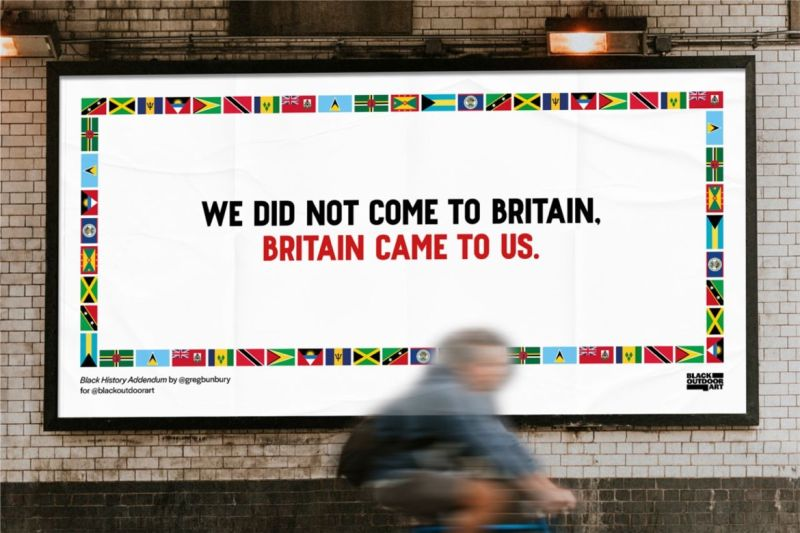
And then there’s Empire. As Greg Bundy has it, “We did not come to Britain. Britain came to us.” (This post is already too long to bring all of that in.)
A pluralism of engagement isn’t going to be easy. Nor will people easily feel that their identity, and all they hold dear, is being protected. Their experience is their experience.
But a definition of Britishness that ignores our history? That ignores the role of Empire in bringing the world to us? That forgets how the British reputation for tolerance attracted those Sephardic Jews (and Huguenots and radicals like Karl Marx and many more?) who brought the fish and chips?
For fuck’s sake. What could be less British than the Right being against Empire and our past? And they call themselves patriotic.
No better proof that monoculture is bad for you than believing that there is such a thing as pure Britishness, sourced only from these isles. Or that it is British to go back on your word.
Now to watch footballers (like Salah, a Muslim) from around the world play in the English Premier League while drinking an IPA (Indian Pale Ale) at my local pub (which serves pizza).
[Chippy update. A couple of weeks have passed since that first tweet. I’ve been back. The last lonely hard-boiled egg and gherkin are still there.]
Elsewhere in Absurdity...
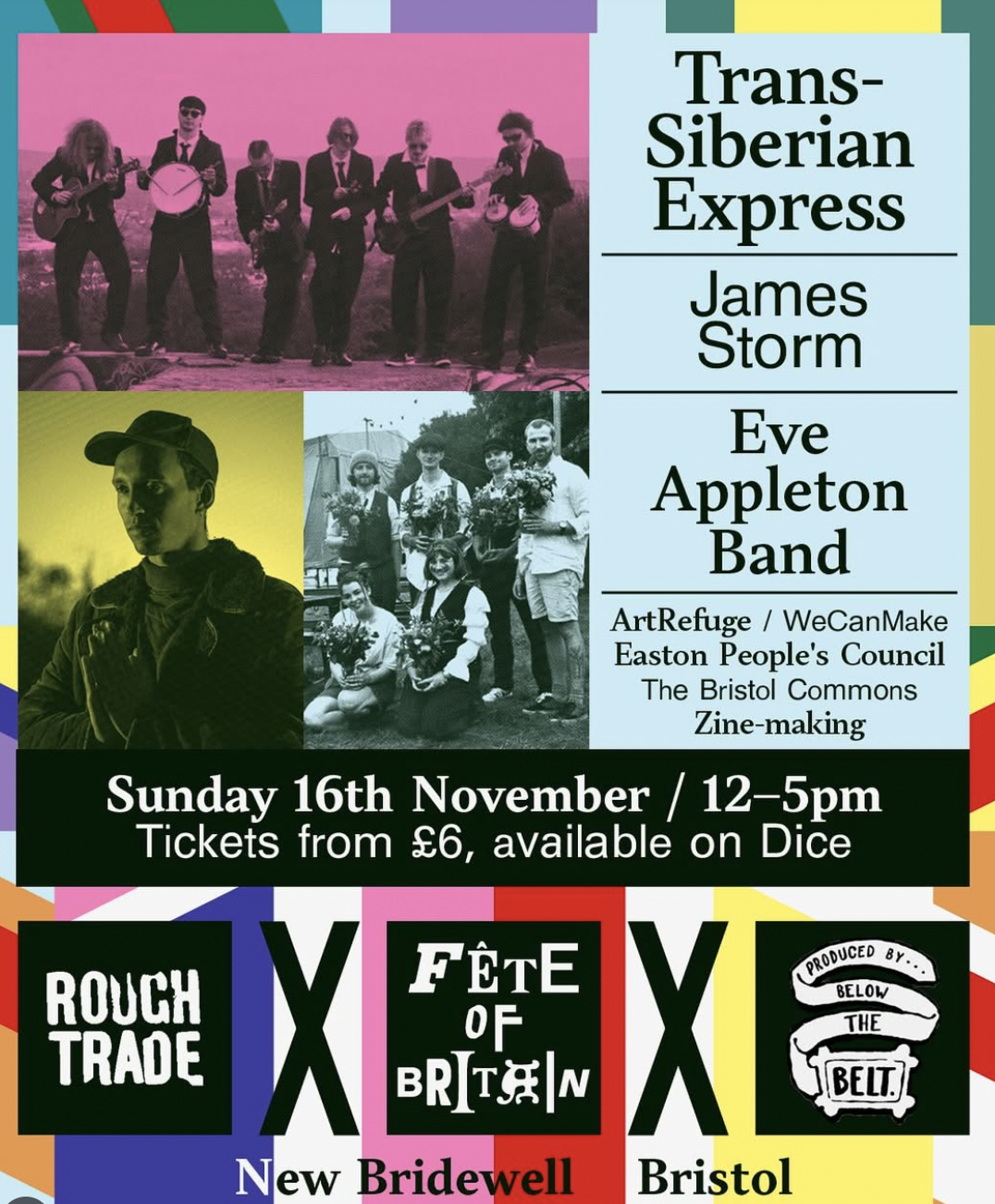
On Sunday Sophie, Maddy, Alanna, Charlie and Clive will all be down in Bristol for Fête of Britain x Rough Trade, a glorious blend of music, art, culture, community organising and people to shine a spotlight on how we can come together to make decisions and look after where we live. If you live in or around Bristol or just want to be a good neighbour get yourself down there!
- Closer to home, on Tuesday our dear friend (and landlord) Jeremy Till along with others from the MOULD collective launched their brilliant new book Architecture is Climate, which you can read more about here;
- Today (Thursday) Charlie and Alex are off to the London Design Museum to celebrate with OSF for their 50th issue celebrations;
- And we’re now purchasing our tickets to support two wonderful experiences, Jan Woolf’s play Porn Crackers Upstairs at the Gatehouse, and Louis VI’s Nature Ain’t a Luxury at the Barbican.