Being Cockney
If someone told you your local identity was dying, what would you do? Andy Green co-founded the Modern Cockney Festival.

I’m quite a stupid person in that if I see something wrong, I feel I should do something about it.
So when media stories appeared a few years ago, following a sociolinguist report that “Cockney was dying on the streets of London” it led to, now in its third year, the Modern Cockney Festival (March 1st-31st).
On one level this is a story about standing up for who you are, where you’re from, and fighting for a right to tell your story.
On another level, it’s a story that says: if you follow your instincts on what you think is right, something quite profound can emerge from your actions.
It’s an important thing to do right now, because there’s a lot of talk about English and British identity, and who gets to claim it.
So, let me tell you the story of how the Modern Cockney Festival came about.
Being Cockney
I’ve been Cockney for… well, all my life. Being Cockney – or what we like to call, being a non-posh Londoner – is a great privilege, great fun, and a proud identity.
So when a sociolinguist wrote a paper describing modern day street language as ‘Multicultural London English’ (MLE) and claiming it has ‘replaced Cockney’ and pushed Cockney out of London, it rang alarm bells (and not Bow Bells) for me.
Forgive me, but first of all: Cockney has over the centuries always been multicultural, with its evolving culture and language, growing from every new wave of inputs. Think how many Yiddish words are absorbed in the Cockney lexicon.
By calling something ‘multicultural’ and comparing it to something it is replacing, you are saying what went before isn’t multicultural. By claiming this something ‘new’ has replaced Cockney cuts the thread to that composite lineage, the linkage between people’s story of today and what’s gone before, denying Cockneys – and all Londoners – a connection with a rich heritage and powerful values of defiance and resilience, resourcefulness, underpinned by a stoic and irreverent wit.
So, when I heard this, I knew I had to do something. And I didn’t do it alone.
The fird of the fird
The initial response to this ‘apparent’ death of Cockney was to create ‘Speak Cockney Day’ on March 3rd – the fird of the fird as a Londoner would say – to provide a memorable date, with an idea of doing an online event called ‘Is Cockney dying?’.
It wasn’t easy at first.
After writing to various museums and Cockney notaries to take part in the talk, I didn’t hear a dickie bird, until just two days ahead of March the fird two sociolinguists, like London buses, arrived at the same time saying they’d take part.
An evening spent setting up an Eventbrite and hammering at dozens of Facebook groups led to, much to my astonishment, 70 people turning up, including Saif Osmani, a Whitechapel-born Bengali artist.
Saif, who co-founded the Bengali East End Heritage Society, and I talked for weeks afterwards. We realised we had much in common, sharing a passion for celebrating our shared culture, and the need to do something urgent.
Taking Cockney lessons
We learnt an awful lot in those weeks of talking.
Lesson number one we discovered: working-class cultures and heritages don’t have cultural institutions to define, defend, or advance their collective interests. Their story, as a result, gets told, mis-told, negatively stereotyped, ignored – or as in the case of Cockney, airbrushed out of existence.
Lesson number two: we came across tacit evidence – you won’t see this written down anywhere – that Cockney was perceived as exclusively white, working-class, with racist tendencies. Just see any media stereotype of a racist, and what accent do they have?
Lesson three: there is incredible complacency among public bodies about responding to the growth of populism and a drift to the right.
Lesson four: we discovered the ‘Brahmin Left’. A label created by French political economist Thomas Piketty, that informs the must-read ‘Outclassed: how the left lost the working-class, and how to win them back’ written by Professor Joan C. Williams of the University of California, who’s doing the first talk of this year’s Modern Cockney Festival.
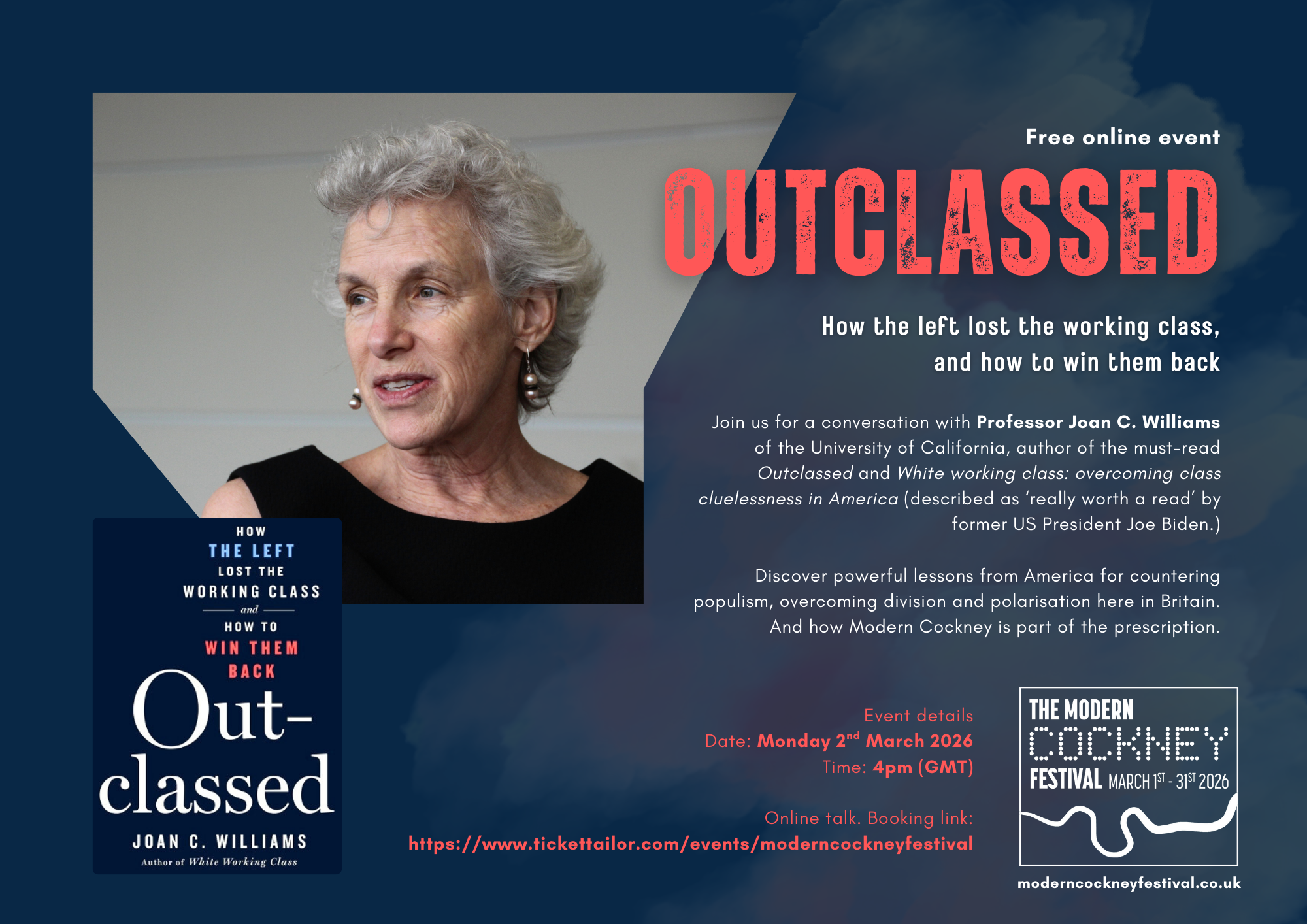
The ‘Brahmin Left’ explains how the Left has become more university educated, and uprooted from its former working-class bedfellows. In many instances, from our experience, they now have, at best, an unconscious bias against the working-class.
In the real world
So how does all this translate into the real world?
It compounds media stereotypes. My granddaughter comes out of the cinema and asks ‘Granddad, why do all the baddies talk like you?’. Dick van Dyke in Mary Poppins may have had the worst-ever Cockney accent, but at least his character Bert was a good guy. When was the last time you saw a positive portrayal of a Cockney in a mainstream movie?
It leads to the Office of the Mayor of London producing a cultural strategy report in 2018, whose title isn’t meant to be ironic, called ‘Culture for all Londoners’. In its 180 pages, 35,000 words, guess how many times the word ‘Cockney’ appeared in it? Zero.
No wonder that sociolinguist all those years ago thought he’d done some good work by introducing the idea of Multicultural London English.
He was wrong. But the stereotypes and the misjudgements still remain.
And that’s why we’re still running the festival.
The Modern Cockney Festival
This year’s Festival, all produced on zero budget despite approaches to the Lottery and Mayor of London’s Office, features live opera, poetry, theatre and museum family fun day events, walking tours, online events covering politics, sociolinguists, the 90th anniversary of the Battle of Cable Street, and how to trace your Cockney family roots.
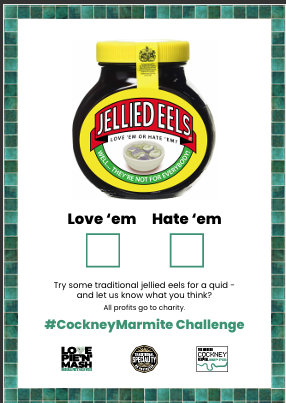
It also features National Pie’n’Mash Week where we started the campaign to secure Protected Food Status for the traditional Cockney cuisine, leading to the first-ever debate in the House of Commons about the Cockney Ambrosia. We’re also inviting everyone to taste the ‘Cockney Marmite’ aka jellied eels and celebrate the birthday of world-famous Cockney, Sir Michael Caine.
And for good measure we’re launching a crowdfunder where you can buy your own ‘pocket museum’ of ‘The story of Cockney in 50 objects’.
The festival is just the most visible part of our work to establish the modern Cockney story, relevant to people of different backgrounds and beliefs.
Evolving Bells
At one of our events, the broadcaster and comedian Arthur Smith defined Cockneys as ‘non-posh Londoners’, an apt definition for our age where social identities are complex, multi-faceted, and fluid.
We’ve also evolved the myth of being a Cockney from ‘being born within the sound of Bow Bells’ to saying ‘Bow Bells are heard through the heart’, emphasising its original meaning as a metaphor rather than an audio boundary.
We identified four types of Cockney:
- ‘Old School’ – characterised by traditional stereotypes of accent and rhyming slang.
- ‘New School’ from a more diverse range of global backgrounds.
- The ‘Cockney Diaspora’ found mainly across the Southeast of England away from its traditional inner London heartlands.
- ‘Ancestral Cockneys’, such as actors Charles Dance or Helen Mirren, who have strong and inspiring Cockney family roots.
We also campaign for better respect and recognition of Cockney culture.
660 years of history
For example, we successfully petitioned Tower Hamlets Council to recognise Cockney as a community language in the delivery of its services. May not seem significant but this was the first-ever formal recognition of Cockney as a culture in its 660-year history.
This then led to the question: ‘What is modern-day Cockney and how can we enable public bodies to embed it in their policies and delivery of services?’. A co-written report with the University of Warwick, ‘A Cockney Blueprint’ provided the answer, along with creating our very own virtual museum ‘The story of Cockney in 50 objects’.
We inspired the East London Music Group to produce an opera, celebrating the life of Nellie Cressall, one of 30 Poplar Councillors who, in 1921, were imprisoned protesting against an unjust rates system. Remarkably, Nellie was six months pregnant. A national outcry ensued and the then Home Secretary sought to release her. Nellie refused to go unless the other 29 councillors were also freed. They eventually reached a compromise where Nellie was evicted from Holloway prison.
Nellie’s story is worth celebrating. In an age where we need new political heroes, we’ve found some old ones.
Cockney cocktails
Why are we doing it?
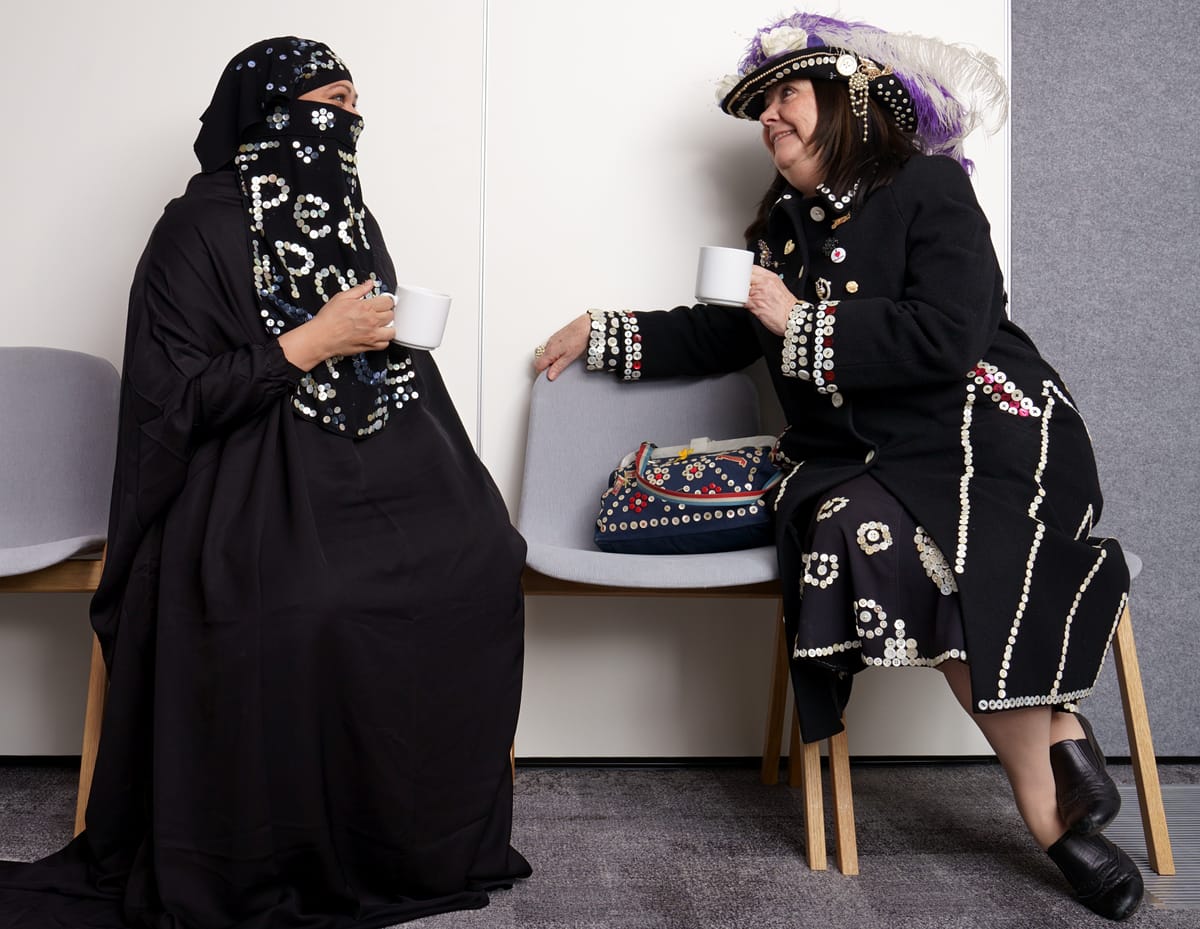
As the Pearly Queen of Woolwich told us, “This is the first time in my life I’ve felt like I’ve had permission to explore who I am.”
Identity in modern Britain is a rich cocktail, and if you have an affinity with ‘non-posh Londoners’ (or be inspired to celebrate other local identities) you and the world are richer from it. It makes you more confident, connected, and builds a greater sense of togetherness.
Celebrating all this doesn’t sound so stupid to me.
Tune in for Good Neighbours TV: Thursday 1pm!
Good Neighbours TV is the magazine livestream for culture and community organisers, shining a light on the incredible people who really keep this country running. Last week Clare, Alex, Jess, Diya and the crew filmed from Braziers Park in Oxford, an intentional community 75-years-strong, with guests from the Humanity Project’s weekend of Grabbing Hope. The show goes on air 1pm Thursday 26th Feb on the Fête of Britain’s YouTube channel. Sign up for a reminder or subscribe now!
Elsewhere in Absurdity...
We’re sending this newsletter out before Mercury goes fully retrograde, although of course you’ve already started being exposed to its shaky misinterpretations. Well, better blame the stars than the sleeplessness from a brilliant, brilliant weekend at Braziers Park (see above) with what is beginning to feel like a real family of people and organisations making a new world of bottom-up power, and doing it with love, care and freedom.
As we’ve said before: The Network is the Strategy. But what we really mean is that it is the relationships that are going to get us out of this mess. What we are hearing more and more is that it is trust that is at the centre of building the new world that we need. And trust takes time. It takes spending days, weeks, months together with people you didn’t know that well, but now do.
Which is why...
Sophie and Tracey visited Barking on a recce, and Alanna did the same in Swansea, for our upcoming Fête of Britain events. More soon...!
Clive was part of the Ocean Rebellion performance at the 2026 Norway–UK Seafood Summit at the Fishmongers’ Hall, read all about it:
 Clive Russell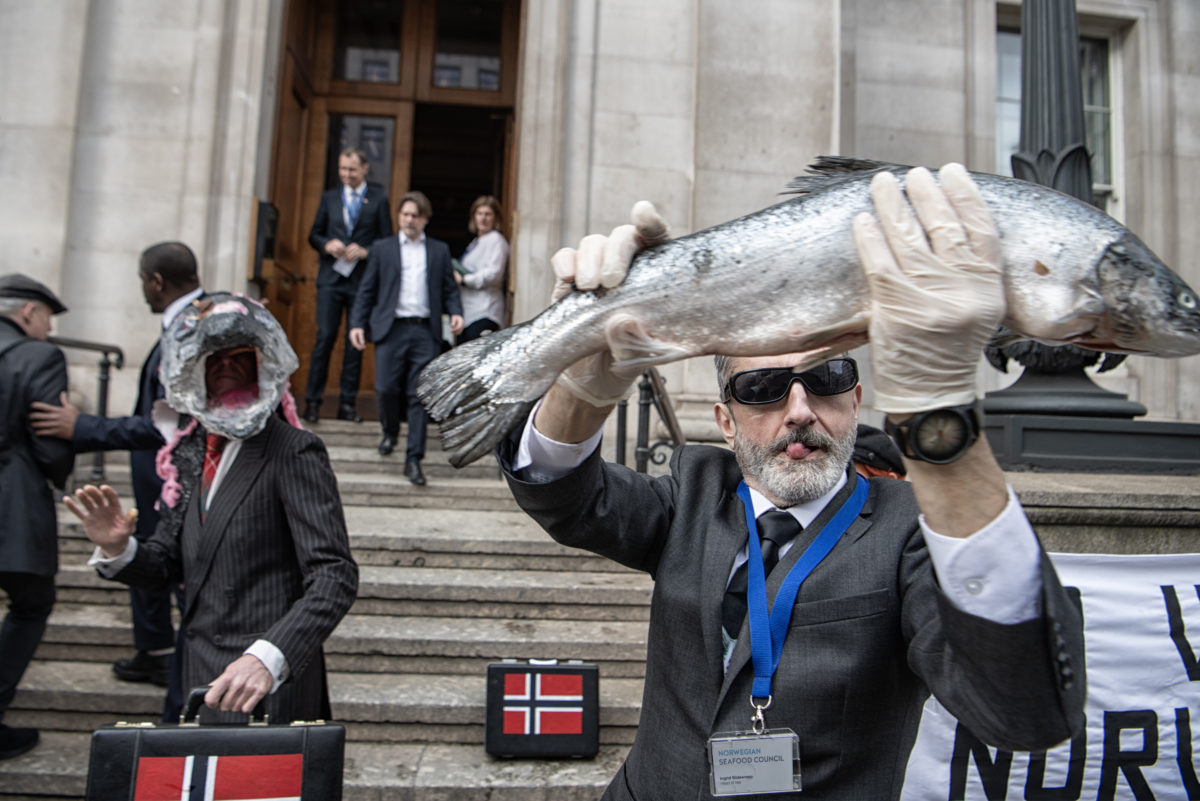
This Wednesday is the first reading of Stella’s play at Guildhall, about a group of teenagers trying to save their local greenbelt from destruction, through progressively mystical and nefarious means.
Alex was lucky enough to spend an afternoon with the Global Citizens Assembly and the author Jim Bacchus, former US Congressman, sponsor of the bill that put the International Space Station into space(!) and author of the new book Democracy for a Sustainable World: The Path from the Pnyx.
Clare is off to see Cable Street: The Musical, a dazzling portrait of a community against fascism.
David, Charlie, Sophie, Diya and Maddy all attended the Hard Art pub night; a feature is the Soap Box, where there were call outs for, among other things, a brilliant book event, a way to get involved with Hope not Hate, the announcement for the NEAC Climate Emergency Prize 2026, and a request to get out on the streets of Gorton and Denton this Thursday.
Sophie and Clive (and Miles!) helped put on and run the Oz Sucks open studio event exploring free speech and creative dissent with our friends Paris68Redux.
Alex also attended the Future Governance Forum’s lunchtime session on Pride in Place, where trust was the central theme (brilliantly facilitated, well done FGF.)
Last word... please sign up for our dear friend Anthea Lawson’s new newsletter.