Are theatre, dance and communal experience the keys to unlock our future world?
It's possible for us to survive into radically different futures with our humanity intact. But how will we stay in our hearts and minds on the journey?

The co-founder of Extinction Rebellion Clare Farrell is working on a new Constructive Programme for the UK – you can follow progress on her Substack. It is inspired by Gandhi’s original constructive programme for Indian independence. Both constructive programmes are oriented around a spiritual grounding for practical revolution; both call for a flexibility of mind and heart to keep our humanity intact in this difficult work.
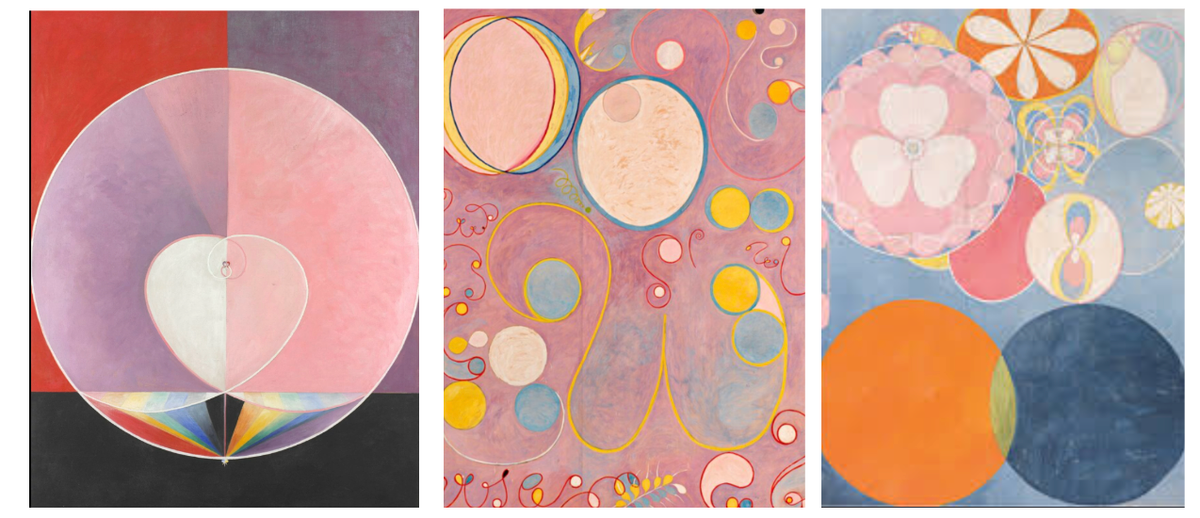
I am lucky enough to work with Clare on the programme. This call for flexibility of mind and heart has made me want to contribute. I think of it as an ever-expanding, morphing, physical manifestation of empathy. It would be like navigating a psychic and mystical landscape that pulses and shifts intuitively and responds to the slightest change. It conjures up visions of soft colours and round shapes caught in a slight haze, like a Hilma Af Klint painting. There is something cellular and corporeal about this vision. This practice occurs within my own biology.
Practice and embodiment
The question of how we survive into radically different present moments with our humanity intact is at the heart of the work we do at Absurd Intelligence.
Maintaining a flexibility of mind and heart, for me, comes down to practice and embodiment. Our hearts are a muscle working tirelessly to keep our blood pumping through our bodies, keeping us alive. But we need to be more than just alive in these times – we need to be connected. So exercising our metaphorical heart through actively engaging in embodied connection allows us to experience living in radically different present moments. These moments are fleeting, precious and hard to capture but immensely moving.
I have felt these alternative present moments most powerfully when I enter a different world or different stories through theatre and dance. The theatre is a transformative space, one that contains embodied and experiential possibility. Whilst humanity has existed, we’ve had performance and ritual to help us process, empathise, commune, divine and connect. This experience of a shared feeling and a shared experience is profoundly uniting. This unity feels more necessary than ever.
“Solitary pleasures will always exist, but for most human beings, the most pleasurable activities almost always involve sharing something: music, food, liquor, drugs, gossip, drama, beds.”
― David Graeber, Debt: The First 5,000 Years
Creating common experiences
I come from a practice of storytelling and theatre making. I’m interested in creating common experiences that don’t require people to articulate anything, but where we can sink into a story, dancefloor or song. The embodiment of the experience allows for you to be anonymous, egoless and connected. In these moments we are creating radically different ways of being.
Anna Ciaunica is a professor working in philosophy and psychology, exploring self-consciousness and how it develops in relation to our body and our physical and social environment. She says:
“shared experiences are phenomena emerging first and foremost from a ‘meeting of bodies’ rather than of minds and as such they precede rather than presuppose empathetic abilities.”
It is through these embodied experiences that empathy can grow.
What art does
In a recent conversation with Clare Farrell, the artist and musician Brian Eno spoke about his ideas of “what art does”'. For Eno, as he puts it, “It allows us to play out real world scenarios in a safe context.” You can read more here:
 Clare Farrell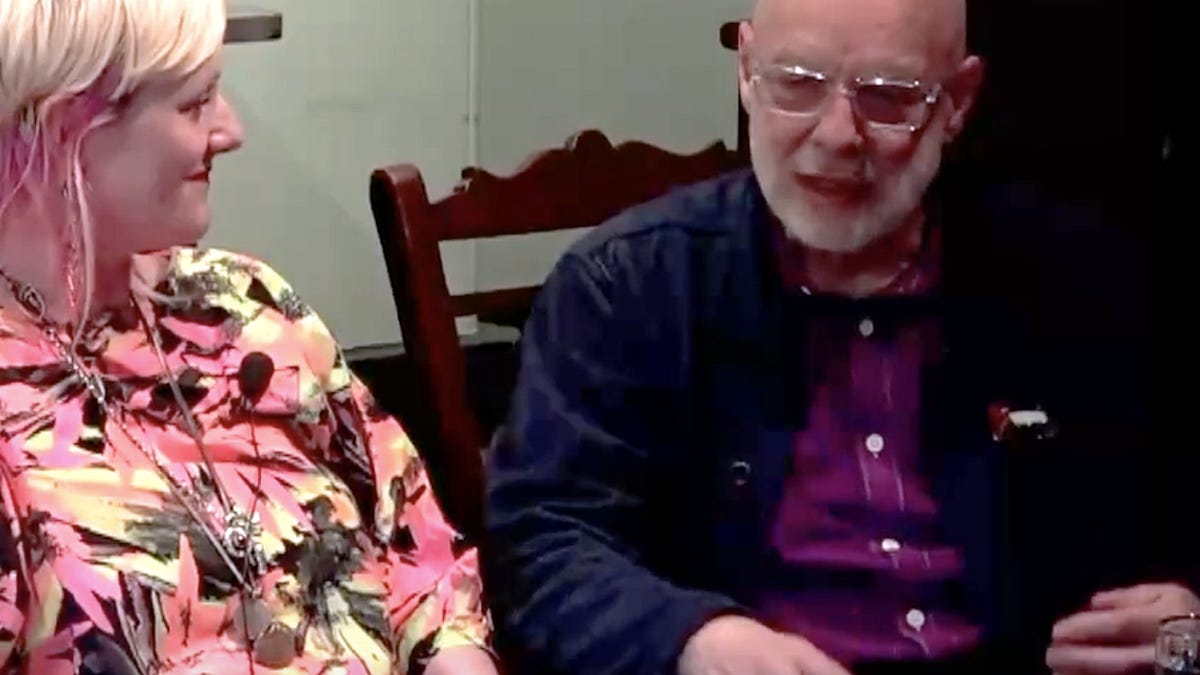
Two plays I saw recently that embodied this particularly well.
The first was The P Word, directed by Anthony Simpson-Pike. The second was Welcome to Pemfort written by Sarah Power and Directed by Ed Madden. These pieces felt like they were exercising my empathy muscles. The stories are about redemption, oppression, rehabilitation, survival and community. They invited their audience to inhabit worlds we wouldn’t normally have access to. This allows us to practice our empathy, so when we are confronted with similar scenarios in real life we can draw on the emotions we all felt together as an audience. Of course music and literature also do this, but there is something unique and raw about theatre which facilitates communal feeling, learning and a sense of embodied immediacy.
You may have read last week’s piece by Ed Gillespie from the Out There Arts festival in Great Yarmouth. Ed wrote:
This manifests in the patience and support of the crowd, the love for the performers and the collective willing for success, with audiences rapidly rallying behind artists when occasionally things don’t always go entirely according to plan.
There is a certain risk involved in theatre that derives from it being live; one that not only connects an audience to each other but connects an audience to its performers, creating a beautiful interdependent relationship. In performance there is no barrier; there is nothing to hide behind. As a dancer, actor, performer you have to show up as purely yourself and hope your audience receives you with empathy and kindness. And we as the audience have to open our hearts and trust that the performers are going to carry us through an experience. The audience’s generosity lies in surrendering to the experience being offered by the performers. The more you give the more you gain. This is how we keep our humanity intact: by selflessly giving, trusting and allowing ourselves to receive even if we don't understand exactly what it is we are experiencing.
Ritual facilitates connection
It is a ritual that facilitates this connection. I felt the power of this meeting of bodies recently, when I went to see the performance Salt by Contemporary Ritual Theatre. It is a haunting show where the audience sits in a circle and the actors moved within and without the circular stage they have created. The only thing on stage: a rope and a candle. The performance is full of song, dark mythology, symbolism and conjuring of spirits. Chatting to some of the audience afterwards, lots of people expressed being very confused at first but then felt a sense of allowing themselves to surrender to the performance and the experience.
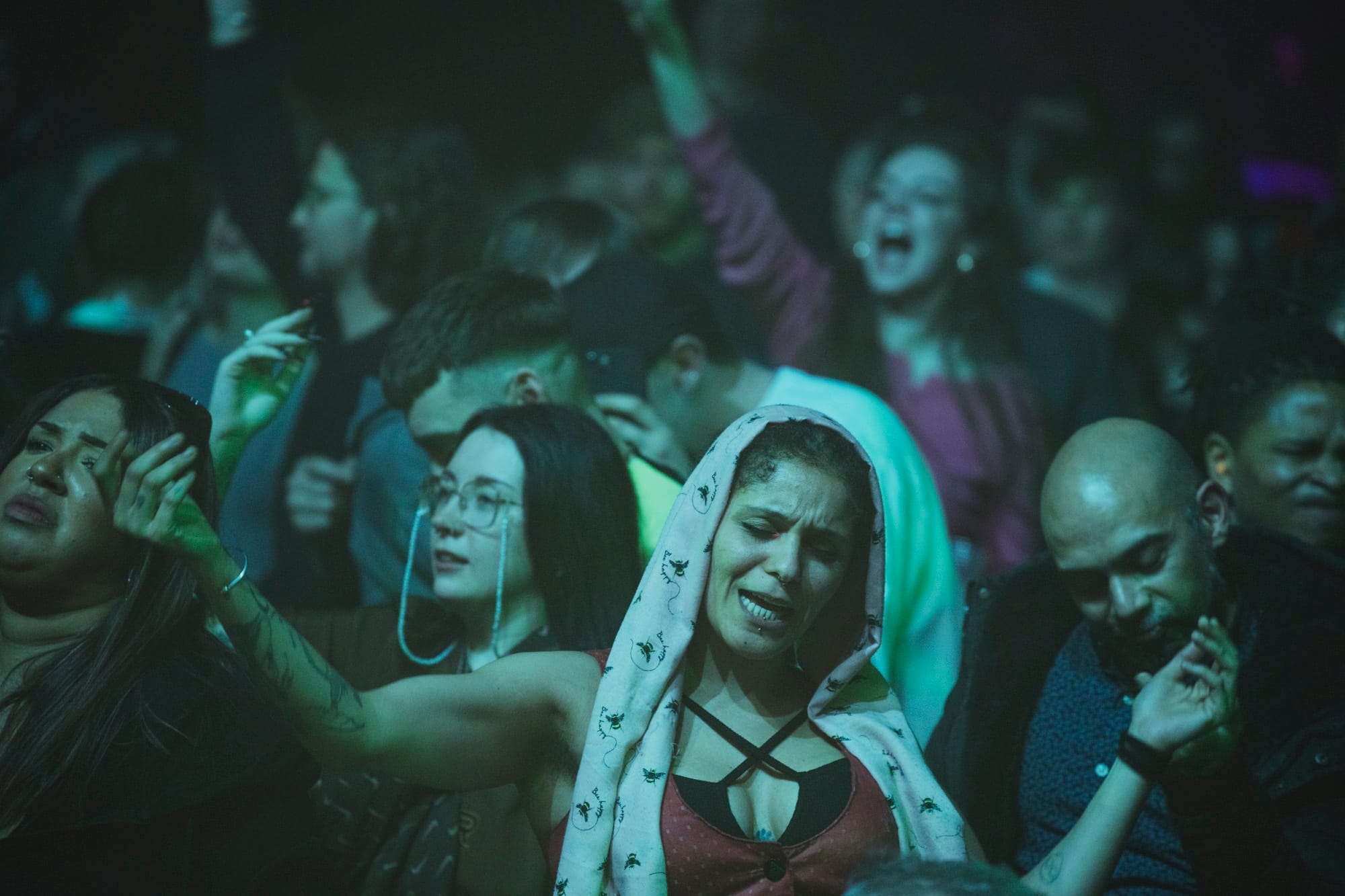
I feel a similar experience when I go to a club to dance. The slow but inescapable release of selfhood. There is relief in being part of a bigger, moving, heightened ensemble.
Martha Newson, a cognitive anthropologist and chartered psychologist whose work centers around the use of evolutionary theory to understand human behaviours, puts it like this when talking about rave:
“Liminality describes a withdrawal from the culturally normal modes of social action, in which ego may be dissolved and new perspectives gained. This ‘betwixt and between’ state facilitates communitas by homogenizing secular distinctions like rank or status, instead replacing them with intense comradeship and egalitarianism.”
It makes me think of the dance practice of flocking: inspired by bird movements, where no one dancer leads but everyone has to listen to each other's bodies and intuit how the group will move next, with the goal of always remaining as one. This kind of intuition, this surrendering to collective empathy feels like an antidote to a world where our attention has been turned into currency, our emotions are manipulated by politicians in order to divide us, our hearts exhausted by endless atrocities. Newson writes that, “Dance as flow merges the dancer with the act resulting in loss of identity and a fusion with the wider world.” This act of giving and exchanging is the muscle we have to work in order for our hearts and minds to remain flexible.
Ritual bridges gaps
The link between rave and theatre is ritual; ritual helps keep our humanity intact through fully engaging with the present moment.
This is what ritual does: it bridges gaps, it connects us to each other and to our sense of identity and belonging. It offers us a sense of otherness and magic that allows us to imagine other worlds, newer and better ones that require a different set of values, ethics and connections. It helps us feel part of something bigger, more important and profound than merely what school you went to, what party you support and or what job you have.
These kinds of experiences remain in our subconscious, ready for when we need to draw them into our lives. The gift the artist offers us in exchange for being open and trusting is that we get to inhabit radically different present moments. On a systemic level, this plays out, for example, as people reimagining forms of governance to be more empathetic. Or in reimagining food systems to be more humane. People come together to celebrate and mark time and occasions such as the parade celebrating Arsenal’s recent title win, or like Pride, or like the Fête of Britain.
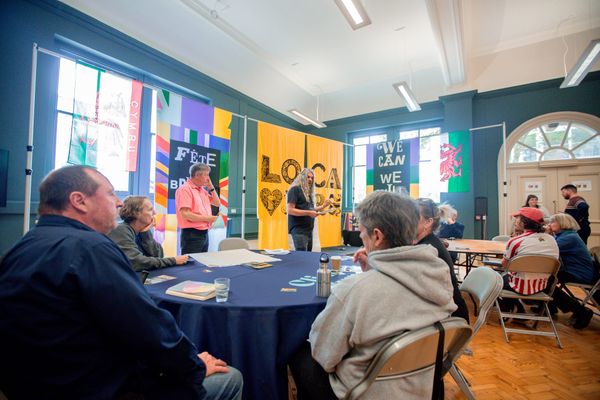
We are always thinking about how we can make the things we do, such as The Fête of Britain, and our show Good Neighbours, more immersive, more experiential, more communal and ritualistic. That’s because we know that if we are to build the new world we need celebrations and rituals that help keep our humanity intact.
Praxis makes it better
We need to practice heart and mind flexibility. This is something active and alive that we need to engage in; it is not something that simply happens because we want it to. The most joyful, engaging way to do this is to physically come together and surrender to feeling. We need to start paying more attention to the moments in which we feel different, altered, connected, or moved. It is then that we can think about how we create more of these moments, how we make them last in order to live in the world where love feels like the axis around which we spin together.
Elsewhere in Absurdity
I (Alex) am writing this from The Moon Under Water, a packed lunchtime in the Wigan Wetherspoons. I’m here not only to see the present moment unfold in the Makerfield by-election, but also to feed up on the breakfast before meeting artists (including tattoo artists), makers, activists, organisers, venues and generally good people of Wigan and Leigh, as we help support and celebrate the work that’s already happening here leading up to our Fête of Wigan (& Leigh!) come this Sept/October.
The Fête of Britain is our campaign for in-real-life democracy, creating the spaces where people can re-learn and rehearse the skills we need to live well together; skills that have been taken from us in the current political system that has stopped working for ordinary people, many of whom are here for the breakfasts and lunches in The Moon Under Water. Our mission is to bring back those spaces for people to practice those skills: listening to each other, speaking well, making decisions together, and remembering that it is okay to disagree agreeably, in ways that bind us together rather than push us apart. And it’s a cultural invite – to a Fête, of all things – because having fun and being joyful is important. It is what a real democracy should feel like.
So hello from Wigan and Leigh, and if you’re reading this around town, let me know and we will come say hello.
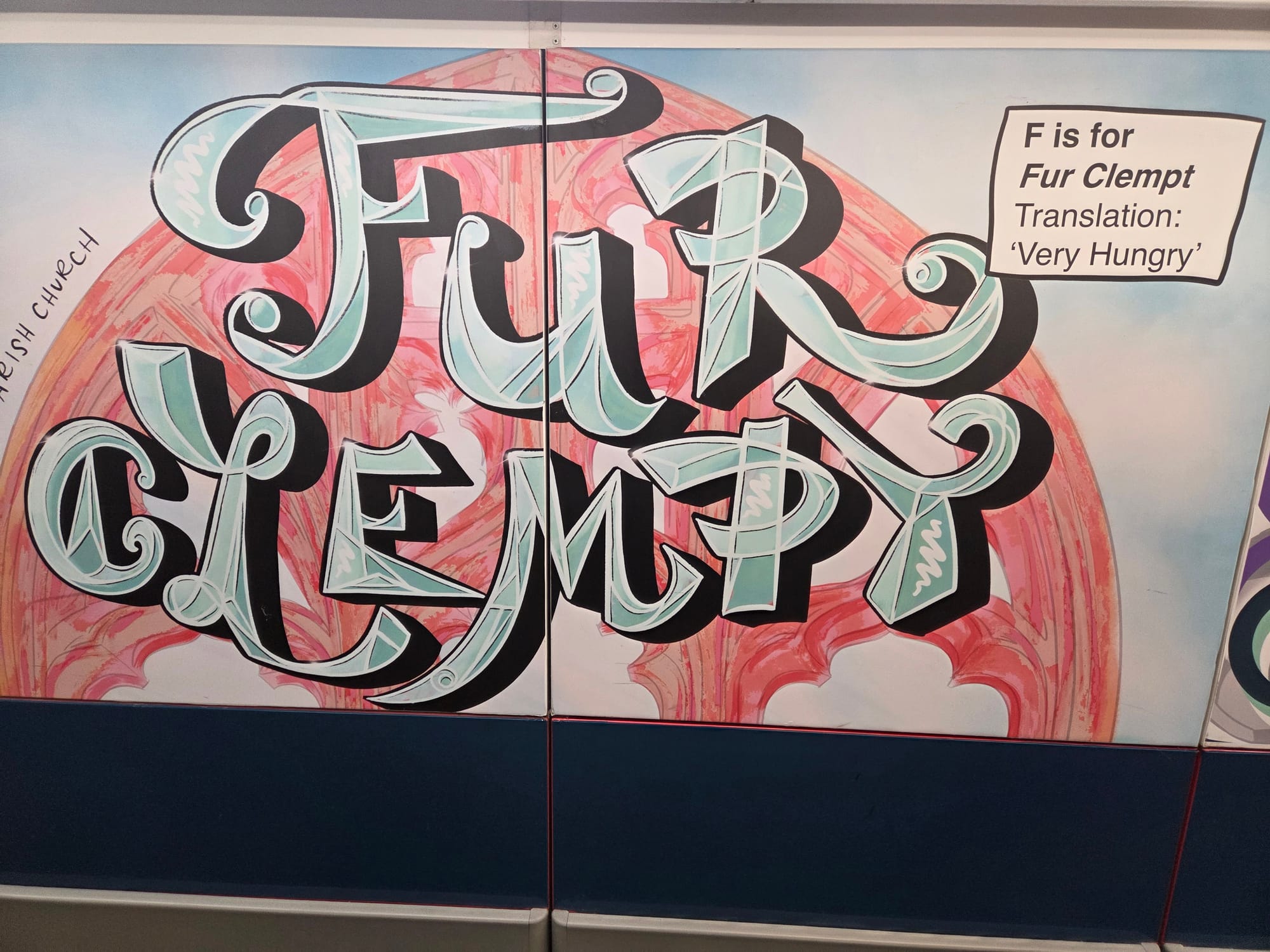
Meanwhile, elsewhere:
- Clare popped in to experience the Maryland Big Lunch on Sunday.
- Tracey attended a book talk featuring Stella Dadzie & Pratibha Parmar:
We Are Each Other’s Liberation: Black and Asian Feminist Solidarities at the Feminist Library. - Tracey also attended a lovely documentary screening and food writers talk at the British Library: The Legacy of Edna Lewis, a Black America chef (born 1916), who shaped modern cookery.
- David joined MPs, special advisors and political journalists in the rain at the Diageo Summer Drinks Party in the College Gardens of Westminster Abbey.
Short this week as Charlie Hustler had a week on holiday.